
McConomy family underline lack of faith in ICRIR and demand answers for 11-year-old shot by British soldier
Stephen McConomy’s family have said they have no faith in the ability of the Independent Commission for Reconciliation and Information Recovery (ICRIR) to provide justice.
Stephen died after being shot in the back of the head at close range by a British soldier in Fahan Street on April 16, 1982.
He was 11 years of age. The schoolboy’s family have been seeking justice for their loved one for the past forty three years.
His brother Emmett, however, has no confidence in the ICRIR being able to deliver that.
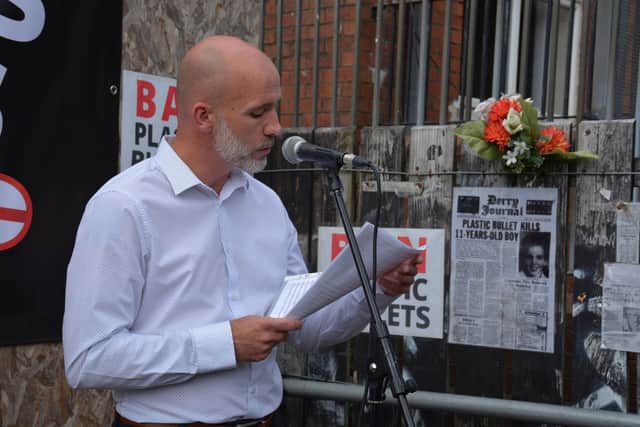

“All families have a right to seek truth and justice if that is the path they wish to take,” said Emmett.
"Stephen’s death ‘should be independently investigated … and, if the evidence meets the legal standard, as we believe it does, there should be a prosecution.”
Stephen died in the Royal Victoria Hospital on April 19, 1982, three days after being shot by a Lance Corporal of the Royal Anglian Regiment.
Witnesses denied there was any significant rioting going on in the area and noted that the boy – who posed no threat – was fired upon from close range.
Those who wanted to check on Stephen were warned they too would be shot. His injuries were horrific and he never regained consciousness.
After a three day vigil his mother Maria made the unbearable decision to switch off life-support.
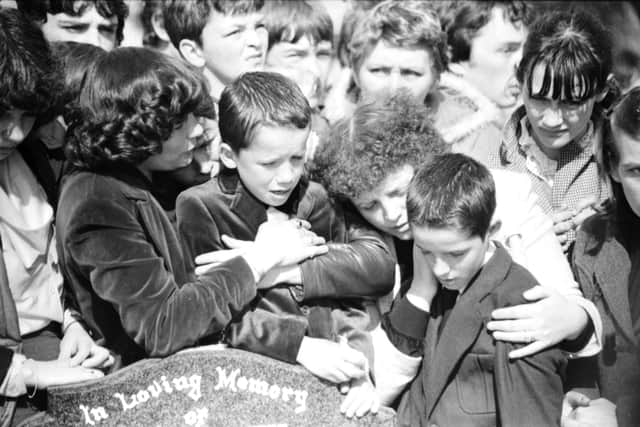
Over one thousand mourners attended Stephen’s funeral. As the ‘Journal’ noted, despite so many violent deaths in the city over the years, rarely had ‘there been such feelings of profound grief and sadness manifested as those witnessed’ that day.
The soldier who shot Stephen was interviewed under caution at Strand Road. According to a report drafted by British Irish Rights Watch the ‘interview lasted just over an hour and appears to have been little more than a formality’.

Within months it was confirmed that the Director of Public Prosecutions would not be charging the soldier. No reasons for this decision were given and this caused outrage.
The fact plastic bullets ‘can be used irresponsibly with apparent impunity from law makes the situation very serious indeed’, said Dr. Edward Daly.
“The police didn’t investigate his death to the standards that we would have expected when a child has been shot and killed,” said Emmett.
"In fact, to add insult to injury, the police – accompanied by soldiers from the same regiment that shot Stephen – raided the McConomy household less than six months later.
“They spent more time in the family home than they did questioning the man responsible for his death,” he added.
The ICRIR was established under the Legacy Act but will not be abolished despite pledges in the British Labour Party’s general election manifesto.
Since taking office Labour have made it clear the ICRIR will be retained. Speaking in Derry in July 2024 Secretary of State Hilary Benn said he was not in favour of abolishing the ICRIR but said he accepted that, as was, the Commission was not independent of the Secretary of State, and that he planned to make changes to its operational structure.
The Labour party professed then that ‘the Legacy Act denies justice to the families and victims of the Troubles’ and it promised voters that ‘Labour will repeal and replace it, by returning to the principles of the Stormont House Agreement, and seeking support from all communities in Northern Ireland’.
While this summer Mr. Benn was understood to be preparing to table legislation to repeal and replace the act the ICRIR will remain.
The Pat Finucane Centre blasted the decision by the British Labour Party - despite pledges to fully repeal and replace the NI Troubles (Legacy and Reconciliation) Act - not to get rid of it the act in its entirety.
"The new Labour government have said they will repeal the Legacy Act but they are not prepared to scrap the ICRIR. This has angered many families here, particularly those who have lost loved ones to State violence,” the group said.
The PFC expressed concern about RUC officers and British soldiers working on the ICRIR.
"Serious questions have been raised over its independence and ability to carry out human rights compliant investigations into legacy-related killing here,” said the PFC.
In response to the concerns raised by the McConomy family and the PFC, the Commission stated: "The Commission is committed to serving victims, families and survivors.
"Over 200 people have asked the Commission to investigate on their behalf. Almost 90 of those requests, relating to over 140 deaths during the Troubles/Conflict, have already moved into the active investigation stage.
"These victims, survivors and families come from every background and community, and their numbers continue to grow. The Commission welcomes the commitment by Secretary of State Hilary Benn to repeal the Legacy Act and fundamentally reform the ICRIR ‘to further strengthen its powers and independence’.”
The Commission insisted it is independent and capable of providing information and answers to families.
“The High Court and Appeal Court in Northern Ireland have clearly and unequivocally declared that the ICRIR is an appropriately independent public authority, both operationally, organisationally, and in relation to its governance and sponsorship arrangements.
"This is settled case law, with the UK Supreme Court recently dismissing a challenge to the independence and effectiveness of the Commission on the basis that it did not raise an arguable point of law,” it stated.
It pointed to ‘a detailed conflict of interest policy to deal with actual and perceived conflicts of interests and can take a range of steps to maintain public confidence in the investigative process and our adherence to our values of openness, respect, objectivity, impartiality and accountability’.
"We respect people’s choices about whether they come to the Commission and our door will always remain open to all. We will continue to work to give answers to the over 200 individuals who have to come to us in their quest for truth and justice,” it said.