
100 years since Derry republican Francis Owen Lafferty aka Jim Davis was released with the Peterhead Ten
The liberation of Derry republican Francis Owen Lafferty from Peterhead prison in Scotland 100 years ago has been marked in the Seanad.
The Bogside-native, also known as James Davis, was among ten republican prisoners released from the Aberdeenshire jail on January 26, 1926.
"Among the large body of insurgents [held in the prison] was a group of ten men,” the Irish Labour Party Senator Nessa Cosgrove told the Seanad, “comprising five volunteers and officers from Leitrim, three from Longford - Frank Reilly, William Reilly and Joseph Lee - along with the famous Sean Flood from Dublin and Jim Davis from Derry.”
"These were called the Peterhead Ten because they were held in the brutal Peterhead prison in Scotland and were among the last IRA prisoners to be released from British prisons in 1926,” Senator Cosgrove declared.
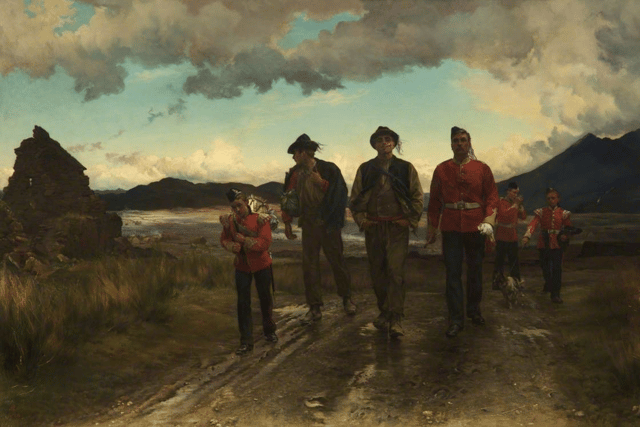

Davis, his nom de guerre at the time, had served over four years of a five year sentence on charges of felonious possession of firearms when he was released in early 1926.
Years later in correspondence with the Department of the Defence in relation to his military pension, Lafferty explained how he had ended up serving penal servitude as a POW in the North East of Scotland.
He had, he recounted, enlisted with the anti-Treaty IRA in September 1921 and went into active service in the Sperrins south of Park.
"I joined the 2nd Northern Division at Cranagh, Sperrin Mountains, Co. Tyrone, and served as Brigade Training Officer until December 21, when a raid was made on the camp and I, along with three others, were arrested.
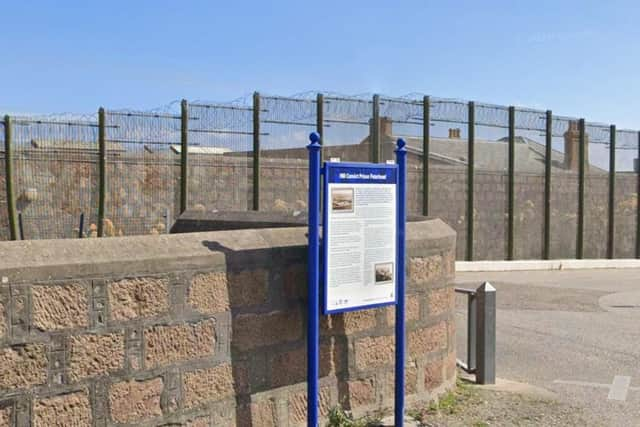
"I was tried at the Winter Assizes at Omagh, Co. Tyrone, and sentenced to five years penal servitude. I was sent to Peterhead Prison in Scotland to serve my sentence.
"I was released on the expiration of my sentence on January 26, 1926," he wrote.
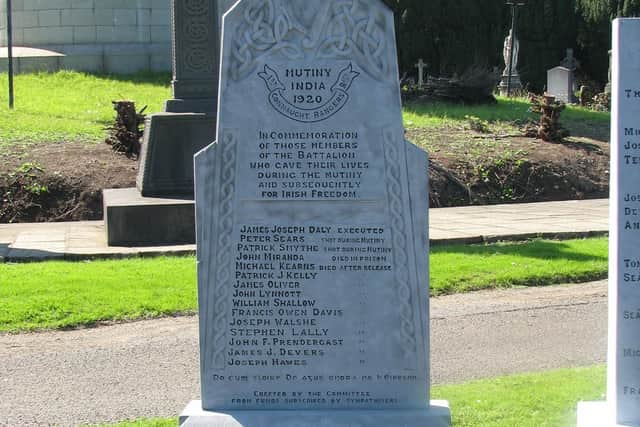
Davis’ incarceration and release with the Peterhead 10 is perhaps less remarkable than his earlier involvement in the mutiny of the Connaught Rangers in the Punjab on June 28, 1920.
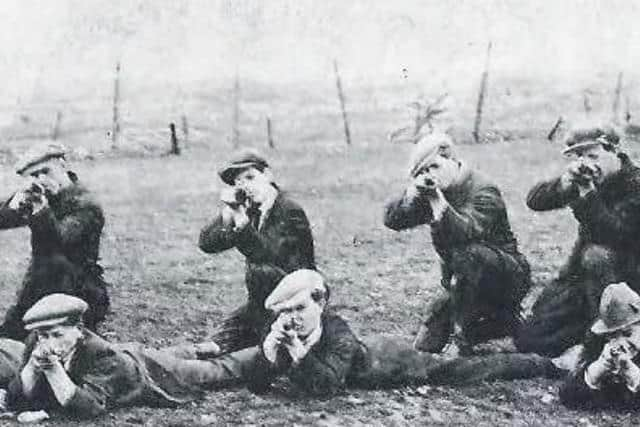
The Derry-man was a leading member of the regiment that refused to obey orders and flew Sinn Féin flags and Irish tricolours from their compounds in Jalandhar in protest at the behaviour of the British Army during the Tan War.
He was court-martialled and sentenced to imprisonment for his involvement and transferred to England to complete his sentence in a Surrey jail.
"When under going sentence over the mutiny in India I escaped unaided from Woking Prison. As well as I can remember on September 1, 1921, I made my way over to this country and joined the IRA two days after landing,” he later wrote.
Light on Lafferty/Davis’ dual identity has been shed by local writer and activist Robin Percival in an article entitled ‘The Connaught Rangers Mutiny in India: the Derry connection’ that is available on his blog A Clear Day.
Percival explains Francis Owen Lafferty was born on Rossville Street on June 7, 1883, to ‘Patrick Lafferty, a cattle dealer and his mother Rose Lafferty, née Doherty’ and that he had changed his name to James Davis because he had joined the ‘Royal Navy in 1898 (aged 15)’ but went AWOL after three years.
This is confirmed by Davis, who in correspondence with the Department of Defence in the 1930s, explained he joined the British Navy on October 10, 1898 and served in it until the end of November 1901. Consequently, he required a new identity when he went to enlist in the Royal Munster Fusiliers in 1901.
His military records show he joined the Connaught Rangers in 1919 just under a year before the Indian mutiny.
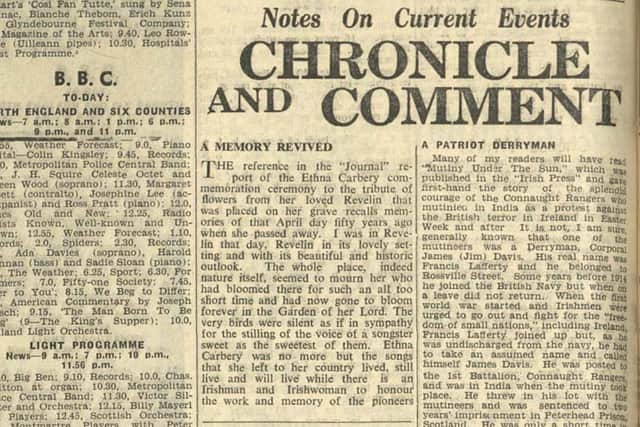
In the article Percival thanks Stanley McWilliams for alerting him to the existence of an piece published in the ‘Journal’ under the ‘Onlooker’ moniker on April 7, 1952, that revealed Francis Owen Lafferty and Jim Davis to be the same person.
It describes him as 'A Patriot Derryman' and hails his courage in rebelling against 'the British terror in Ireland'.
"It is not, I am sure, generally known, that one of the mutineers was a Derryman. His real name was Francis Lafferty and he belonged to Rossville Street.
"Some years before 1914 he joined the British Navy but when on a leave did not return," wrote 'Onlooker'.
The piece confirms how Lafferty - still undischarged from the Royal Navy - needed a new alias in order to join the British Army.
It states that after his escape following the mutiny in India he 'got back to Derry and joined one of the IRA Flying Columns, which he served with distinction'.
Upon his release from Peterhead he was, however, unable to return to his native Derry and so settled in Dublin where he was appointed a caretaker at the National Museum.
"He died three years ago. He is another Derryman of whom Derry has a right to be proud and whose memory it should hold in affectionate remembrance," 'Onlooker' concluded.
Percival writes that Lafferty played a major role in the Indian revolt.
“As the first day of the mutiny came to an end, he was one of seven men elected to lead the mutiny. As one of the Committee of Seven he was given the responsibility to secure and ultimately to hand in the weapons of the mutineers.
"They were subsequently transferred to an internment camp where Davis was again elected by the men to lead one of the four companies which they established.
"At one stage Jim Davis along with the some of the others came within a whisker of being shot for refusing to obey an order. They were saved by the last minute intervention of a priest.
"Jim Davies was one of the first men to be court-martialled. He was sentenced to a two year prison term which was low considering what many of the other soldiers got. One of them, Private James Daly, was executed,” he informs us.