
An event that shaped a city told in a new way : Screening of 'The Day Innocence Died - Bloody Sunday and the Fight for Justice'
The terrible events of Bloody Sunday and the campaign for justice is something everyone in Derry is familiar with, but a new documentary film is telling that story and its relevance for Palestine and other justice campaigns across the world in a unique way.
For film-makers Hannan Majid and Richard York of Rainbow Collective, it is was vital that their new film, 'The Day Innocence Died - Bloody Sunday and the Fight for Justice' carried the authentic voice of those who have lived Bloody Sunday; that their documentary was of and about the community without any State or other broadcast editorialising or omniscient narrator.
And that is what you get with this production, developed in association with the Bloody Sunday Trust and Museum of Free Derry by an organisation whose other recent film ‘To Kill a War Machine’, chronicling the direct-action tactics of Palestine Action, was banned.
The new Bloody Sunday film largely consists of interviews with relatives, eyewitnesses and others who have been involved in the campaign for justice, interspliced with archive, authentic footage and images.
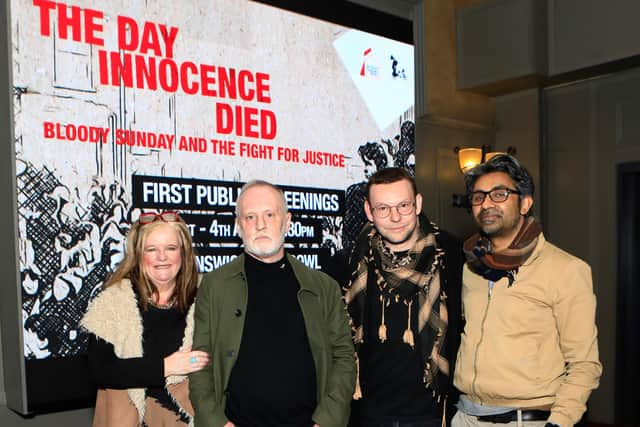

Here, people are given the chance to speak freely, space to reflect, to tell the truth of what happened their way and to shame the actions of the State whose agents committed mass murder in the Bogside on January 1972.
There are some new insights about the long campaign for justice divulged within this documentary which alone make it worth the watch, but it is that authentic collective voice of relatives, eyewitnesses and justice campaigners that stays with you. Furthermore this is the first film produced about Bloody Sunday since the trial of Solder F concluded, and thus it brings the story full circle as it traverses the journey that accompannied the three central demands of the families’ campaign, how they achieved what they achieved, and how they exposed a State.
It also touches on the solidarity between Derry and Palestine, and how the Bloody Sunday families’ campaign for truth and justice has inspired others across the world.
For the England-based film makers, who plan to show this film in cinemas in Britain and possibly elsewhere, the parallels between what happened on our streets and what is happening in Palestine is clear.
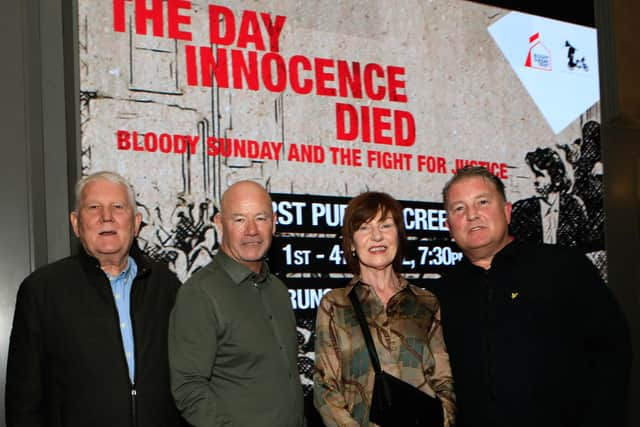
Hannan told the Derry Journal that as a young person growing up in the 80s amid rampant racism and being chased by the National Front with their Alsatian dogs, he was struck by the struggle in Ireland and the US and the solidarity. “That was something that stayed in my head from the 80s up until now,” he said.
The Museum of Free Derry had organised a screening of To Kill A War Machine in Ireland and when Hannan and Richard came to Derry they were deeply moved by the story of Bloody Sunday and struck by the real solidarity with Palestine in Derry. It was then they decided upon the new film.
"Even though documentaries on Bloody Sunday have been done, the stories of the families in the way they wanted to do it have not been done.
“There was an occupation here that also influences the occupation in Palestine; tactics that were used here that then get used in Palestine,” Hannan said.
Richard added that stepping back to allow the stories of the people on the frontline to come to the fire was a deliberate choice. The authentic footage was something they wanted to include alongside that.
"We got this opportunity to get footage that was shot by these amazing filmmakers from over seven decades, and they are part of the struggle as they were filming it on the ground. We can step back, look at it and say ‘OK, we can see parallels’ with what is happening in Palestine, what is happening all over – as Eamonn McCann described it - the blood-soaked empire’.”
He said there were still many in Britain who didn’t understand what happened here.
"With people in the UK there is a blind-spot, even well educated people, people on the left, they don’t realise these massacres, these checkpoints, this level of military occupation happened…. they’re out protesting week in and week out about Palestine – how many of them are truly aware of what was happening on the streets of so-called ‘Britain’ but occupied Ireland? People very close to me, even myself – to my shame - didn’t know the full extent of it, and I’ve got my Irish heritage.”
Bloody Sunday and the story of Derry has the power to inspire people trying to resist murderous fascist and colonialist regimes today.
"The oppression is not going anywhere,” Richard said. "That’s the other thing that led us to tell this story. The importance of solidarity. It is not just words when Maeve (McLaughlin), and Tony (Doherty) and the Bloody Sunday Trust talk about how important that solidarity is. It’s real because these these people feel alone when their sons and daughters and mothers and fathers and sisters and brothers are being killed by the State and they are gas lit and they are told they are the criminals and are spy copped and everything else.
“This iteration of the British state – Bloody Sunday was the formative event, and is absolutely indicative of the State violence you have seen replicated.”
Hannan adds: “The solidarity is essential to the families who struggle alone and the inspiration that gives to the Grenfell families and to individuals who have been murdered by the police. These histories, we want these histories to be told from the perspective of those family members, the people who were there, those people who have been affected – just their stories. When we make documentaries like this we didn’t need to interview the British army, the British government, they had their chance.”
The film is to be screened at Brunswick Moviebowl in Derry from April 1 to 4 at 7.30pm.