
Charles McGuinness: Derry man who sent the Irish Tricolour on first flight to the South Pole
It was quite the interview: Richard E. Byrd eyeball to eyeball with Charles McGuinness in a luxury suite in the Biltmore on Madison Avenue.
What, asked Byrd, are the best two jobs you ever did?
"Breaking Frank Carty out of prison under a death sentence. Escaping myself under similar circumstances. I consider those two good jobs,” replied the Derry man.
And why do you want to take part in an expedition to Antarctica?

"There seems no hope of a decent war breaking out in the near future, piracy is difficult to organise, and it's too hot in Nicaragua for comfortable revolution,” he said.
Byrd burst out laughing and signed him up.
The year was 1928 and the US aviator and explorer’s first expedition to the Antarctic had captured the imagination of the American public.
Born in 1893 on the Lower Road in Derry, McGuinness had been a leading figure in the IRA in the city during the Tan War.
The two jobs that so tickled Byrd were, firstly, his rescue of Carty, O/C of the Tubbercurry Battalion of the IRA, out of Derry Gaol in 1921.
The second was his own escape from Ebrington after he was captured on active service while leading an IRA Flying Column in West Donegal.
McGuinness had sawed his way out of the Waterside barracks using hack-saw blades in a cake smuggled to him by Cumann na mBan volunteers. He cleared the wall and swam to a rowing boat in the River Foyle before being spirited out of the city on a coal boat.

Now he wanted the gig of polar explorer. Details of McGuinness’ part in the venture are recorded in his fascinating memoir, ‘Sailor of Fortune’.
After the unusual meeting in Midtown Manhattan, Byrd asked McGuinness to refit a 50-year-old Norwegian whaler called the Samson for a 12,000 mile voyage to the Bay of Whales.
Byrd made him chief officer because, says McGuinness, he would not have been able to tolerate a foreigner in command of a ship sailing under the ‘Stars and Stripes’.
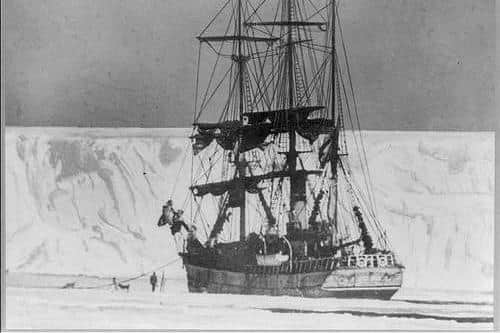
McGuinness wasn’t impressed with the boat, describing it as ‘a small barquentine’. It was fitted, however, and became the expedition’s flagship, City of New York.

The US Congressional Record tells us the bark left Hoboken on August 25, 1928, captained by Frederick C. Melville with McGuinness as chief officer.
From his memoir we know McGuinness disliked Melville: “We were opposite types. The ballyhoo of the expedition and the recent elevation to naval rank had gone to his head. But press clipping was his hobby and dreams of eclipsing everyone on the ocean kept him so busy that I had no interference in the running of the ship.”
They made their way to the Pacific via the Panama canal or ‘the big ditch’ as McGuinness describes it.
Their passage through was largely uneventful except McGuinness nearly got left at Balboa on the Pacific side when he stepped ashore to buy a ship’s bell and have a glass of beer.
They called at Papeete in Tahiti on the way down to buy coal. Amazingly McGuinness was no stranger to the island.

He had been shipwrecked aboard the Pilgrim in the South Seas not long after stowing away at the age of 15 in 1908 for a life on he high seas. He spent several years there as a pearl fisher in the 1910s.
Thus his return was something of a reunion. The first man to greet him when he disembarked City of New York in Papeete, he claims, was the same one that had greeted him when he survived the wreck of the Pilgrim.
"We received a real South Sea welcome from the natives, many of whom I knew from my earlier residence in Tahiti,” he writes, recalling how the locals came in canoes laden with fruit and flowers.
Disgruntled at the pettiness of Captain Melville the crew were relieved at the sight of the Otago Heads as they reached Dunedin around 90 days after leaving the New York shore.
The Eleanor Bolling, the second ship of the expedition, had arrived earlier at Wellington. The steamship was much faster than the City.
Commander Byrd had not travelled with either ship. Instead he had sailed from Los Angeles on the whaler CA Larsen, envisaging that that ship could be used to tow the City of New York through the ice pack.
It was decided the Bolling would tow the City to the ice and the whaler would then take over.
McGuinness was transferred to the Bolling, which suited him well given his dislike for Melville.
On December 2, 1928, the City and the Bolling left Dunedin for the Bay of Whales, located on the Ross Ice Shelf and named by Ernest Shackleton in 1908 for its abundance of cetaceans.
The seas and wind grew in ferocity as they travelled south.
"The Bolling was like a submarine; seas came rolling on board and stopped on board. Our rooms were full of water,” writes McGuinness.
Standing on the bridge and looking at the tow line attached to the City McGuinness could barely see the other boat.
"The mountains of water in between blotted out everything. Sometimes we would see the City surge up on the crest of a wave as we climbed the peak of another,” he relates.
During violent weather the bridle snapped a number a times. There were struggles to get the 30 fathom long steel hawser back aboard.
On December 10 McGuinness spotted ‘two basaltic rocks’ – Scott Island in the Ross Sea.
“They are the loneliest of all islands and their existence in that deserted ocean is a mystery that no geologist can solve.
"One of Scott's lieutenants [Robert Scott who died on the ice shelf in 1912] was the first to sight these lonely rocks and until our advents they had not been seen since; in fact, many seamen were doubtful of their existence,” conjuring the notion of a Hy-Brasil in the south.
Describing the Bay of Whales McGuinness agreed with Shackleton:
"Nowhere in the world have I seen so many whales as in the bay named after these ocean animals. It was not an unusual sight to see from ten to twenty of the monsters swimming across the bay in perfect formation, diving and blowing as if under a skilled sergeant-major whale. Many a mother had a baby by her side, no doubt as proud of her offspring as the most devoted parent in the human family.”
After towing the City to the ice, McGuinness was dispatched back to New Zealand for more supplies.
Indeed this was to be the main function of the Bolling for much of the expedition with the supply ship making the journey to and from Dunedin a number of times.
McGuinness provides a lyrical description of the Earth’s most inhospitable continent.
"Man's efforts are puny against the howling blizzards, the intense cold, crashing ice and yawning chasms which, at any moment, may open under a camp and, in the twinkling of an eye, swallow it entire.
"The surrounding seas teem with icebergs vomited forth by gigantic glaciers, or caused by huge tracts breaking away from the ice barrier, many of these being floating islands miles in extent.”
One of the most memorable incidents of the adventure was a near catastrophe when the Bolling and City were anchored to the ice shelf as supplies were being loaded for the flight to the South Pole.
It was reported in the New York Times under the headline 'Crash of the ice barrier; rescue of Benny Roth' with the paper lionising the ‘heroism’ of Commander Byrd.
Part of the ice barrier imploded throwing a couple of hundred tons of ice on the Bolling, which nearly foundered.
Mechanic Benny Roth was thrown into the Southern Ocean. Byrd dived into the freezing water after him. McGuinness rolled his eyes.
"He was numbed and frozen in the ice-cold water and in imminent danger of drowning or being crushed. His act was a courageous piece of folly,” he writes.
McGuinness helped launch a life boat.
"Rescuing the rescuers was almost fatal to poor Benny Roth. Captain Brown [Gustav L., master of the Bolling] and I launched the life-boat and we picked up de Ganahl [Joe] and the sundry life-belts and rings which had been tossed overboard. Meanwhile, Lieutenant Harry Adams, mate of the City of New York, rescued Benny Roth in a dinghy.”
The Congressional Record states that on January 31, 1929, ‘Commander Byrd saved Roth, aviation mechanic, from drowning when part of the barrier cliff collapsed’. Not according to McGuinness.
Camp had been set up at ‘Little America’ but the ships were ordered back to New Zealand to wait out the antipodean winter and the closing in of the ice pack.
Time passed quickly and on November 28, 1929, Byrd, Harold June, Captain McKinley, stepped aboard the Floyd Bennet, piloted by the Norwegian adventurer Bernt Balchen. They reached the South Pole at 8.55am New York Time, the first people to ever have completed the feat.
McGuinness, the former IRA Flying Squad leader from Derry who played such a pivotal role in the accomplishment, tells us they had with them the Irish national flag when they made the historic flight.
The City of New York successfully renegotiated passage out through the ice pack in February 1930.
McGuinness, in ‘Sailor of Fortune’, professed himself bewildered at some of the panicked radio calls for assistance that had been made.
“We could have negotiated the pack with a dinghy and outboard motor, but that, although a record-breaking feat, would not have had the sensational value of the dread or danger of an unconquerable pack,” he muses.
They eventually sailed back up across the Pacific, through ‘the big ditch’, and on June 19, 1930, landed to great fanfare at the pier at Battery Park.
"On July 5, Jimmy Walker, Mayor of New York City, presented Jack O'Brien and myself with an official and public reception at the City Hall, where I presented him with an Irish flag that had been flown over the South Pole.
"The Mayor received the flag, to present it later to De Valera [Éamon], leader of the Irish Republican Party in Ireland.”
McGuinness later claims he received a telegraph informing him that the US Secretary of the Navy would present him with a gold Congressional Medal for Service Rendered. This has been disputed. But McGuinness insisted he accepted the accolade.
Sources for this article have included McGuinness’ memoir Sailor of Fortune; US Congressional Record; Dictionary of Irish Biography; New York Times archive; Bureau of Military History.