
Demand for services as high as ever as Foyle Women’s Aid marks 50 years with anniversary of Pump Street squat
Marie Brown has paid tribute to the pioneering women who fifty years ago occupied an old hostel in Pump Street to establish the first women’s refuge west of the Bann.
“It was the beginning of the women's movement in Derry effectively. They were ahead of their time,” acknowledged the Foyle Women’s Aid Chief Executive Officer (CEO) as she marked the milestone in Derry.
"There was a huge problem but they recognised it and took action and did something about it,” she noted.
Over eleven days in October 1976 local women – including community activists Avila Kilmurray and the late Cathy Harkin – established a squat at 24 Pump Street for women survivors of domestic violence and sexual violence.
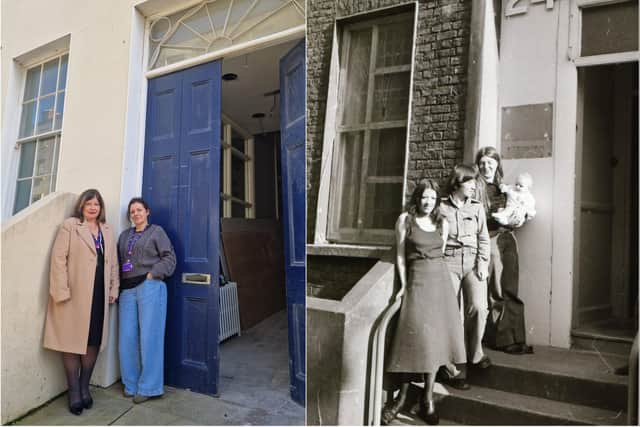

In its first eight months, the refuge had supported approximately 90 women and 300 children, operating entirely through a volunteer-led 24-hour rota.
It had its origins in ‘Operation Desperation’ a direct action campaign that in August 1976 saw squats established in Orchard Street and Clarendon Street.
“It's on those first women that we have built anything that we have done since then,” Mrs. Brown added. “They really led the way and we have built everything from their actions. It was so important. It was the beginning of the women's movement, not just in Derry but across the North.”
That seminal campaign for a shelter was spearheaded by women who had been enrolled on an influential ‘Women and Society’ course at Magee at the time.
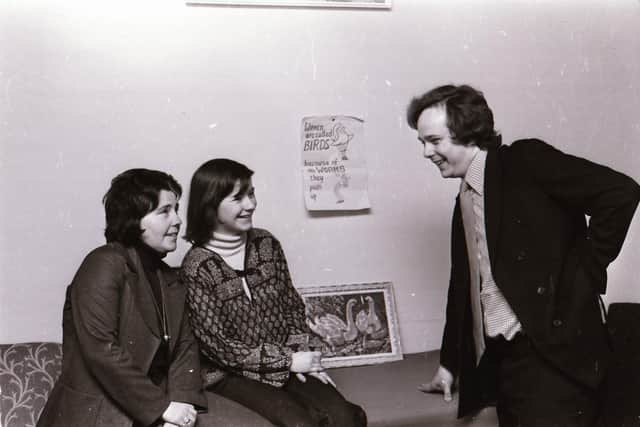
"They led the campaign and took action and squatted into the building,” Mrs. Brown said. “I think they were trying to raise awareness. I don't think they really realised that they would end up having to house people. And because the problem was so bad women opened the doors and arrived.”
Women’s Aid groups were soon afterwards formally established in Derry, Coleraine and Belfast. Mrs. Brown recalls being aware of the agitation as a student at the ‘Tech’ in the 1970s.
Ms. Harkin, who helped set up the refuge, tragically died from cancer in July 1985, but her legacy continues in the organisation she helped establish. Foyle Women’s Aid was formally incorporated in 1989.
Mrs. Brown, a former nurse, joined the charity in 1993. She has been at the forefront of driving its programmes, campaigns and support services since then.
As it marks half a century of providing vital support for local women and children, Mrs. Brown highlights the relentless demand for its service.
Over 70 women a week are reaching out for help on average, she estimated.
"Domestic violence has always been a problem but it has got worse because there is a whole range of ways in which to abuse women now,” she reflected.
Social media and the use of online communications and modern technology to perpetrate abuse and spread misogyny are particularly relevant for young women, she observed.
"We have new tactics with tracking devices, stalking, harassment, because there are new methods of torturing somebody,” she pointed out.
Derry has consistently had large numbers of women coming forward for support demonstrating the scale of the problem of domestic violence and violence against women and girls within society.
Foyle Women’s Aid has also been central in raising awareness of coercive control and economic abuse, which Mrs. Brown noted, have always been present but have not until relatively recently received the attention and policy responses they have merited.
“Coercive control is a big issue and we are also working with Surviving Economic Abuse (SEA) [a charity dedicated towards raising awareness of the phenomenon]. That's about taking money from the family, leaving them without resources. That has always been here but we are starting to try to push that agenda.
"Coercive control now is against the law so we have got that in law now and it has been recognised but it was there 33 years ago when I started,” she says.
Mrs. Brown observed how homelessness can be a disruptive and traumatising factor for women and children who have suffered from domestic abuse.
She also points out that not enough is being done to make the court system more attuned to the needs of victims.
Equally, there is a pressing need for sentencing and policy to be brought into line with that which pertains in Britain.
Marking 50 years of Foyle Women’s Aid, Mrs. Brown said it is hard to quantify how many people have been provided with vital support over the years.
“It's certainly been thousands and thousands and thousands of women. When we started to work in partnership with the police - I think it was 97 women were reporting to the police at that time.
"Now we have 33,000 who are going forward and getting orders and getting protection but we are not reaching all of them. We need to reach more children with programmes and support. There is a lot of work to be done and a lot of investment in the work that is being done,” she said.
As Foyle Women’s Aid marks its 50th anniversary renovations are currently underway at the historic premises on Pump Street where Avila Kilmurray, Cathy Harkin and their sister agitators staged their occupation from October 6 to October 16, 1976.
It is due to be re-opened as a Foyle Women’s Aid multi-service hub next month.
As its CEO explains, the need for such a facility is as acute as ever.
“We have about 70 women a week making calls to come in for services. These are generally women with their children and not all of them are reporting to the police. Then we have sister organisation Assist which is also getting referrals. There are very high rates of domestic abuse still.”