
Derry air failing to meet WHO guidelines for health harming pollutants
The Derry air is failing to meet World Health Organisation (WHO) targets for health harming pollutants generated by exhaust fumes and fossil fuel burning.
A newly published report from the Department of Environment, Agriculture and Rural Affairs (DAERA) shows monitoring stations recorded levels that were above the WHO recommended guidelines for fine particulate matter (PM2.5s), nitrogen dioxide (NO2) and ozone (O3).
Government statistics, DAERA points out, ‘estimate that air pollution in the UK reduces the life expectancy of every person by an average of 7-8 months, with an associated cost of up to £20 billion each year’.
WHO has said that there is a growing body of evidence to show how ‘air pollution affects different aspects of health at even lower concentrations than previously understood’ and has recognised air pollution as ‘a risk factor for noncommunicable diseases such as ischaemic heart disease, stroke, chronic obstructive pulmonary disease, asthma and cancer, and the economic toll they take’.

Air pollution has been monitored annually in the North for a quarter of a century due to the potential short and long term consequences on human health.
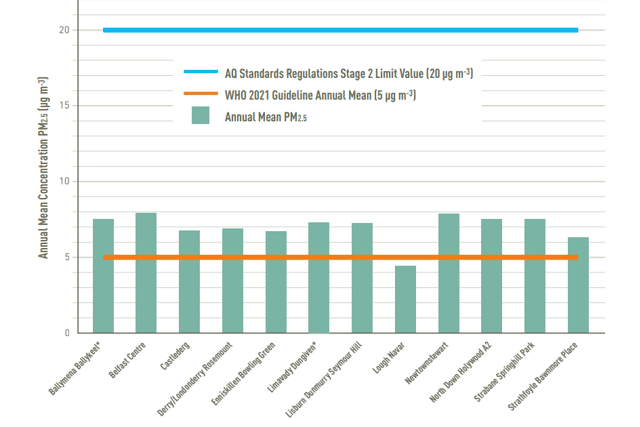
A monitoring station in Rosemount recorded an annual mean concentration for fine particulate matter (PM2.5s) of just under seven micrograms per cubic metre in 2025. WHO recommends annual mean concentrations should be no higher than five micrograms per cubic metre.
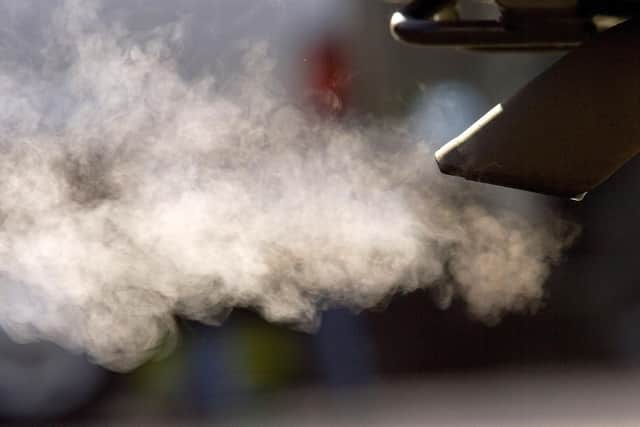
PM2.5s are tiny pieces of solid matter and liquids that can be caused by car exhausts, non-smokeless fuels and industrial emissions and which can be inhaled via the lungs and thus end up in the bloodstream.
DAERA’s 2025 annual report on air quality shows that Rosemount breached the WHO target last year but came in under a less stringent standard of 20 micrograms per cubic metre that was set by The Air Quality Standards Regulations (Northern Ireland) 2010.
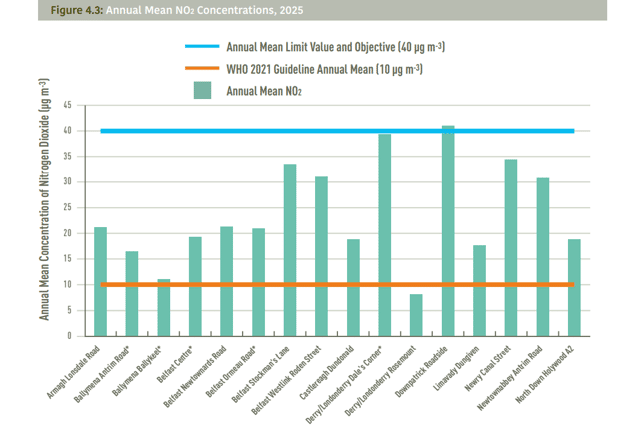
Derry also failed to meet WHO targets for nitrogen dioxide (NO2) with a monitor at Dale’s Corner in the Waterside giving an annual mean reading well in excess of the guidelines.
Dale's Corner came in far higher than the WHO target of 10 micrograms per cubic metre and just under a less stringent limit of 40 micrograms per cubic metre under the UK Air Quality Strategy.
NO2 emissions are caused by traffic, domestic and industrial combustion and energy production.
The toxic gas irritates the airways and lungs and can contribute to the formation of secondary particulate matter.
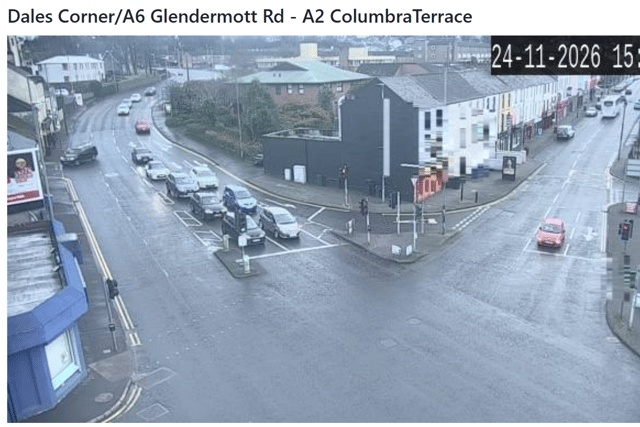
The Waterside junction had a reading of approximately 39 micrograms per cubic metre in 2025 although the authors of the report said the station had very low data capture for NO2 (39%) and its annual mean should be treated ‘as indicative only’.
A monitor in Dungiven also exceeded the WHO target although the Rosemount station came in at under the recommended target of 10 micrograms per cubic metre.
Rosemount, in fact, was the only site in the North that did not exceed the WHO annual mean guideline.
Ozone was also monitored at Rosemount.
The Derry monitoring station was not compliant with the WHO limit of 100 micrograms per cubic metre for its maximum daily 8-hour mean, or with the WHO ‘peak season’ guideline of 60 micrograms per cubic metre.
Rosemount did meet less stringent targets under the UK Air Quality Strategy of not having the maximum daily 8-hour mean exceed 100 micrograms per cubic metres on more than 10 days in the year.
In 2025, the maximum daily 8-hour mean exceeded this limit on eight days at Rosemount.
The report notes that ozone is formed by ‘reactions involving other pollutants, in the presence of sunlight and heat, and over several hours’.
"Therefore, the number of ozone exceedances in any given year depends substantially on weather conditions, with hot, sunny weather favouring ozone formation,” it notes.
The level of Polycyclic Aromatic Hydrocarbons (PAHs) – toxic pollutants caused by domestic combustion – were monitored at four sites in the North including the Brandywell.
One particular species of hydrocarbon, a carcinogenic compound called benzo[a]pyrene (B[a]P), was used as a marker for the purposes of measurement.
The Brandywell recorded the highest level of the four sites in the North with an annual mean concentration of approximately 0.5 nanograms per cubic metre.
This breached an UK Air Quality Strategy (AQS) objective of 0.25 nanograms per cubic metre but was under the less rigorous target of 1 nanogram per cubic metre under the Air Quality Standards Regulations (Northern Ireland) 2010.
“Three sites [Brandywell, Ballymena Ballykeel and Armagh Lonsdale Road] exceeded the more stringent AQS annual mean objective of 0.25 nanograms per cubic metre for this PAH species, which was to have been achieved by December 31, 2012,” the report notes.
DAERA points out that across the North regulations limit values, target values and corresponding UK Air Quality Strategy (AQS) objectives, were met for the majority of the pollutants covered in the report with one exception - nitrogen dioxide.
One roadside site exceeded the annual mean limit value for nitrogen dioxide, the first such exceedance since 2019.
Particulate matter (measured as PM10 and PM2.5) and nitrogen dioxide, however, were above the more stringent (but non-mandatory) WHO guidelines.
WHO’s 2021 air quality guidelines state: “To date, strong evidence shows causal relationships between PM2.5 air pollution exposure and all-cause mortality, as well as acute lower respiratory infections, chronic obstructive pulmonary disease (COPD, ischaemic heart disease, lung cancer and stroke.”
It warns: “Clean air is fundamental to health. Compared to 15 years ago, when the previous edition of these guidelines was published, there is now a much stronger body of evidence to show how air pollution affects different aspects of health at even lower concentrations than previously understood. But here’s what hasn’t changed: every year, exposure to air pollution is still estimated to cause millions of deaths and the loss of healthy years of life.”