
'Don’t make east-west rail divide even worse', urges Derry-based rail lobby group
Rail campaigners have welcomed news that the Infrastructure Minister will publish the results of a number of feasibility studies on rail expansion before the end of this year – but have urged her to ensure she does not widen NI’s already stark regional infrastructure divide when doing so.
Translink has commissioned feasibility studies into a number of potential rail improvements and reopenings across the north.

These include: Reopening the Antrim-Lisburn line, with a link to Belfast International Airport; Restoring rail between Portadown and Armagh; Restoring the Derry - Portadown line - via Strabane, Omagh and Dungannon; Consideration of new rail halts east of Derry – at Strathfoyle, Derry Airport and Ballykelly and Electrifying the railway line between Belfast and Dublin.
In response to a recent question in the Assembly, Infrastructure Minister Liz Kimmins confirmed her intention to release the findings of these studies before the end of the year.
‘Into the West’, whose membership includes campaigners from counties Derry, Tyrone, Fermanagh and Donegal, welcomed this update from the Minister. However – as the majority of the studies propose improving rail in the East of the north, Into the West are urging the Minister to ensure that her decisions moving forwards do not make Northern Ireland’s “already staggering east-west infrastructure imbalance” even worse.
Into the West has pointed out that Northern Ireland currently contains 54 railway stations - only three of which are located West of the Bann (Derry, Castlerock and Bellarena). This means that almost 95% of all railway stations in the north are in the East of the jurisdiction.
Belfast city alone contains 11 railway stations, which is more per head of population than any other city in Britain or the north.
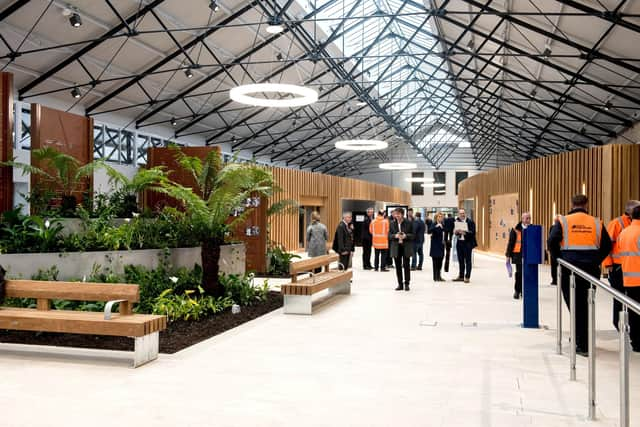
Into The West said that they are keen to see rail expanded in every part of the north and the island as a whole – but also insist that future rail investment must reduce the existing east-west disparity too. They highlight that over a third of a billion pounds has recently been spent on just one rail/transport hub in Belfast – Grand Central Station – "whereas even essential or minor transport investments in the West get continually delayed or canceled”.
Chair of Into The West, Steve Bradley, said: “It’s great that DFI and Translink recognise the huge benefits that more and better rail will bring to Northern Ireland, and we look forward to seeing what their feasibility studies recommend. We are concerned, however, that recent talk has focused almost entirely upon improving rail in the East. For example - work has already begun to create NI’s 55th railway station, at Lisburn West.
"And there has also been much discussion about reopening the old route between Antrim and Lisburn - with four new stations and a link to Belfast International Airport. All such improvements would of course be very welcome. But there are already 51 stations in the East of NI, and only three in the entire western half. So the obvious question must be asked: How many more stations will be created in the East before a genuine effort is made to start closing NI’s absurd regional transport gap? When will new stations and new lines be reopened in the West, given that all the talk and focus seems to be on Greater Belfast and the East?”
Into The West said that rail usage in and around Belfast has declined by 11% compared to pre-Covid levels, whilst the three stations west of the Bann have seen demand soar. Derry in particular has experienced a 78% rise in passenger numbers since Covid, and is now NI’s 7th-busiest station - with almost one million passengers a year.
Steve Bradley said: “NI’s current rail network is primarily designed around short-to-medium-distance weekday commuting in and out of Belfast. Yet the rise of ‘Working From Home’ since Covid has reduced that type of rail travel. At the same time we’ve seen a big growth in rail demand West of the Bann. NI therefore has a pre-Covid rail network that doesn’t reflect our post-Covid world. Yet Translink and DFI continue to double-down by building a network that largely reflects the past. Hence £350m+ spent on just one station in Belfast – where rail usage has fallen significantly - whilst large parts of the West are left as a public transport wasteland”.
Mr Bradley concluded: “Minister Kimmins didn’t create the staggering East-West imbalance in Northern Ireland’s rail provision. But she is the person who is now responsible for addressing it. And at an absolute minimum she is responsible for not making it even worse. It is therefore essential that the opportunity these feasibility studies provide is used to finally start reversing NI’s unacceptable regional transport divide.
"It’s time for talk about regional balance to end and for delivery of it to finally start happening”.
Members of the North West Regional Development Group (NWRDG), a partnership of Donegal County Council and Derry City and Strabane District Council, met with Minister Kimmins back in September to discuss rail connectivity to the North West.
In what was described as “a very constructive meeting”, the NWRDG members highlighted the importance of cross-border collaboration at a national and regional level to ensure that the recommendations of the All-Island Strategic Rail Review to connect both Letterkenny and Derry to the existing rail network at Portadown were delivered.
The group also welcomed the Minister’s announcement back in August to ring-fence £1m in 2025-26 for progressing the All-Island Rail Review proposals, and made the case for a review of rail links along the Atlantic Economic Corridor from Derry to Letterkenny, Sligo, Galway, Limerick and Cork.