
McIlhenny Tabasco – the world’s most famous chilli sauce’s connection to Donegal
Avery Island lies in the middle of Louisiana’s Cajun country, that part of the state west and north-west of New Orleans.
Rural, flat, swampy and humid, the area resonates in its Cajun identity – the Cajuns having been forced out of Nova Scotia (then known as ‘Acadia’) in the 18th century and finally settling several thousand miles south in what is now the state of Louisiana.
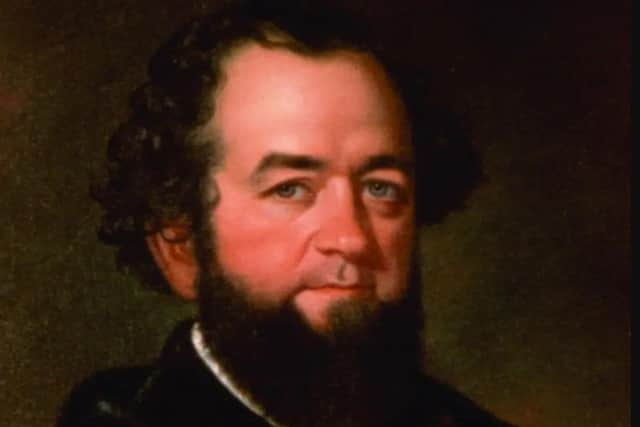
It is also the location of the Tabasco business established in 1868 by Edmund McIlhenny whose family is thought to have emigrated from Donegal to Maryland in the period before the Famine.
The company is still owned and run by the family. Its current Chairman and CEO, Harold Osborn is a great-great grandson of the founder, Edmund McIlhenny.

History abounds with stories of Americans who ‘did well’ in the United States, but relatively few have achieved such success and longevity as the McIlhenny family.
Leaving the Milford area of Donegal (and most likely taking a ship from the then bustling port of Derry) in the early 1840s, Tabasco’s founder, Edmund McIlhenny, originally a banker, first settled in the state of Maryland.
The fact that McIlhenny was of Presbyterian stock and that Maryland was settled mainly as a Catholic colony, is, in itself, interesting. He then set out for Louisiana in 1841 and in 1868 established the Tabasco business.
He is said to have sourced some pepper seeds from the Tabasco region (Tabasco in Mexican Indian meaning ‘place where the soil is humid’ of south-eastern Mexico.
Growing them on site in Avery Island and mixing them with locally produced salt and French white wine vinegar, he produced a sauce that gave a little ‘spice’ to the often meagre, bland meals of the post-Civil War South.
Although now using a longer ageing process for the ‘mash’, that recipe and process is still broadly followed to this day.
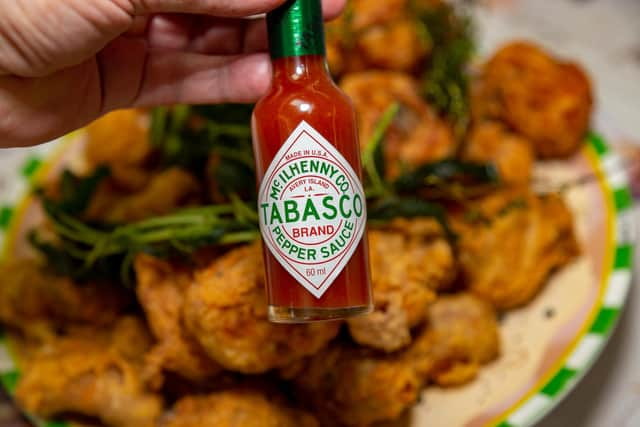
The distinctive small bottles also have an interesting origin. They were originally cologne bottles with a sprinkler filament so that the hot and spicy sauce could be sprinkled as opposed to poured.
A treasured pedestal belongs to those commercial products that have a worldwide ubiquity and have that key ‘recognition factor’. In almost every diner, and most restaurants and bars across the United States can be found a bottle of that hot chilli-based sauce – now the ‘default’ choice for those who fancy a little spicy lift to their meals.
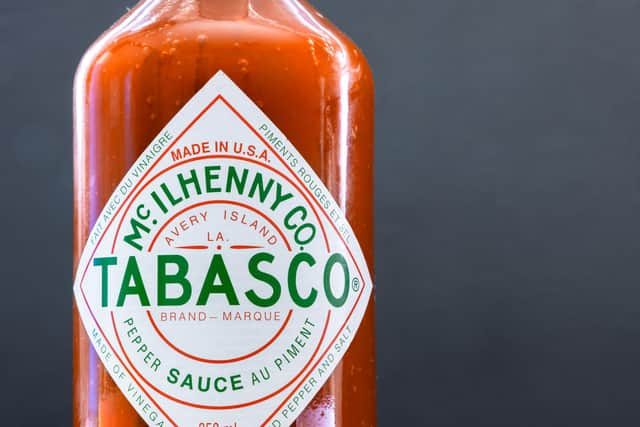
In Ireland and most European countries, Tabasco (with its recognisable yet simple white and green sticker) is on most supermarket shelves and regularly to be found behind bar counters to be used for cocktails.
Tabasco sauce also featured in Charlie Chaplin’s ‘Modern Times’ as far back as 1936, in an era long before ‘product placement’ became common.
Tabasco now exports its products to more than 160 countries and territories from its Avery Island plant where the soil, climate, local salt reserves and quality chilli peppers all combine to make it the perfect location to grow and produce their product.
Exporting rather than establishing plants abroad has been the McIlhenny’s established business model, as the key ingredients and product knowledge are so deeply wedded to the local terrain. The original Tabasco has also spawned many popular spin-offs within its brand.
Tabasco is an integral part of its local surroundings, closely wedded to the local community, some of whom have worked at the plant for five generations – reminiscent of those former mining towns in the north of England in Wales.
Walking round the plant’s precincts, this sense of community struck me forcibly. Employees are deeply aware of the quality and tradition of their products.
Cooking plays a big part in local living and culture – another throwback to the local population’s French roots. Fish and seafood are of the highest quality, with shrimps and crawfish being particularly popular.
The well-known ‘gumbo’ soup, jambalaya and ‘po-boys’ are particular local delicacies. It is no surprise that never far from these local delicacies, one is likely to find a bottle of Tabasco!
In the late 19th century, the McIlhennys forged an important association with a soon-to-be President of the United States, Teddy Roosevelt.
John Avery McIlhenny, who inherited the company from his father Edmund in 1890, resigned from the company a few years later to serve as an officer in Roosevelt’s Rough Riders in the Spanish-America War.
The uniform he wore is among many artefacts in the possession of Tabasco’s historian, Shane Bernard, who eventually envisages it forming part of a Tabasco historical collection/museum.
It is often said that it takes emigration for Irish people to flower to their full potential. Centuries of dispossession and deprivation ingrained into our DNA probably account for this sense of under-achievement at home.
Families like the McIlhennys of Avery Island are an example, however, of the heights to which the Irish in America can aspire.
It takes a long time and a great deal of effort to achieve what the McIlhennys have achieved. Yet, maybe young emigrants embarking on a new future in the US, could look at the McIlhennys of Avery Island and see what can be achieved by the Irish in America through dedication, hard work and community solidarity.
Paul McElhinney is a writer living in Wexford. His main interests are in history, politics, culture and sport. He is author of ‘Lion of the RAF’ and has had articles published in many Irish, British and international journals. He worked in the Department of the Taoiseach in the 1980s and in London and Washington DC in the 1990s. He retains close ties with Derry where his family hails from.