
New pilot aimed at eradicating the deadly disease Bovine TB is to concentrate on Derry and North East Donegal
A new pilot aimed at eradicating the deadly disease bovine tuberculosis is to concentrate on Derry and North East Donegal.
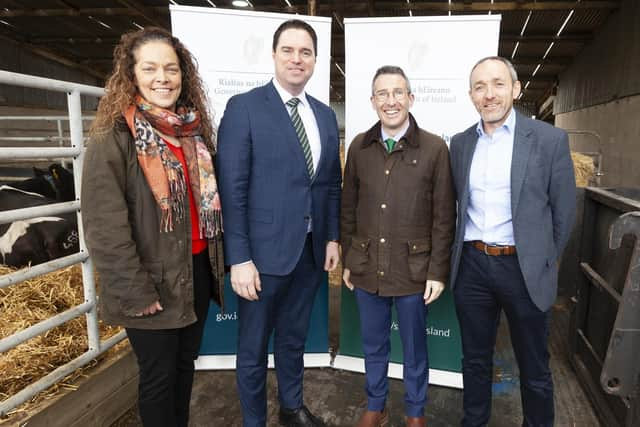
Agriculture Minister Andrew Muir launched the cross-border regionalisation initiative with his southern counterpart Martin Heydon on Thursday.
The pilot will be supported by Shared Island funding. Its purpose is to tackle an illness that regularly devastates cattle herds and farmers’ livelihoods throughout the country.
Mr. Muir said the bovine TB eradication pilot will be focused on north-east Donegal and part of the area covered by Derry City and Strabane District Council.

“The regionalisation pilot will serve as a proof-of-concept model and will enable us to trial, evaluate and refine interventions in that defined geographical area.
“The approach to the TB regionalisation project will include implementing and monitoring measures across the three key themes of wildlife, cattle and people. Work on this important issue is already under way,” Mr. Muir told MLAs this week.
Speaking at the launch on Thursday Minister Heydon said: “I am delighted to be able to formally launch this project along with Minister Muir and progress the work from both our departments in tackling Bovine TB. As a single epidemiological area, it makes sense for us to tackle disease control and eradication together and, with the support provided through the Shared Island Fund, I look forward to seeing positive outcomes from this pilot project.”
Mr. Muir added: “Today marks a significant milestone in our collaborative efforts to combat Bovine TB across this island. The launch of this research proof-of-concept project epitomises our commitment to finding innovative solutions and advancing TB control and eradication.
"Farmers are at the heart of this initiative, and their insights and experiences are invaluable in shaping future policies and strategies. We look forward to the positive impact this project will bring to our agricultural community and beyond.”
The initiative was welcomed too by the Taoiseach Micheál Martin, who said: “I am delighted to see this cross-border cooperation programme on tackling bovine TB, as part of the Shared Island Initiative, get underway. Across the island, the challenges and opportunities we face in many sectors are both comparable and inter-connected, including in agriculture.
"I look forward to seeing what positive impacts this project will have in supporting farmers across the selected region to prevent and eradicate this disease.”
Bovine TB can be spread to cattle from badgers with catastrophic consequences.
Speaking in Stormont prior to the launch Mr. Muir said the new pilot will involve wildlife sett surveys that commenced in January, ‘with land access for the work secured across the vast majority of the designated area’.
"Some 86 per cent of local farmers have granted permission for access. That shows exceptionally strong cooperation and engagement from the farming community.
"The sett survey work, which will last for 12 weeks, will provide essential ecological information for wildlife intervention and TB breakdown management,” he stated.
Addressing the matter in the Assembly he said all factors contributing to the spread of ‘this terrible disease need to be tackled if we are to set NI on a path towards eradication’.
It was confirmed on Thursday that the project involves the application of a series of enhanced TB controls by both the Department of Agriculture, Environment and Rural Affairs and the Department of Agriculture, Food and the Marine.
The additional controls on the Donegal side will be aligned with Dublin’s recently published TB action plan, addressing additional testing regimes, providing intensive biosecurity training to farmers, and wildlife controls.
In the North, the project will involve additional cattle testing regimes, research on the development of an appropriate wildlife controls, and intensive biosecurity training to famers.
There is no pre-existing wildlife programme in the North and substantial resources will be deployed establishing the wildlife element.
Because there is a net movement of cattle out of both Derry and Strabane and North East Donegal there is a reduced risk of inward disease introductions.
There is a substantial research element to the project, where the learnings from the project will be applied more widely in both jurisdictions, the departments said.
All mammalian species, including humans, are susceptible to bovine TB.
DAERA guidance points out that the illness is caused by the bacterium Mycobacterium bovis (M. bovis) which can also infect and cause disease in many other mammals including humans, deer, goats, pigs, cats, dogs and badgers.
Cattle become infected when directly exposed to infectious cattle (or other infectious animals) and their excretions. The movement of cattle with undetected infection is the most likely way that disease spreads to new areas.
The project aligns with both Departments’ strategies on the eradication of bovine TB and the objectives of the Shared Island Initiative of working together on an all-island basis to address common strategic challenges.
Through the Shared Island Fund, the Government of Ireland will contribute €6.5 million towards the total projected costs (€11.7 million) over the five-year period of the pilot project, with the remaining costs being funded by the Department of Agriculture, Food and the Marine and the Department of Agriculture, Environment and Rural Affairs, as applicable.
Following public engagement with stakeholders in late 2025, the project will continue its scoping exercise for research strands over the coming months.
The holistic package of measures, which seeks to address sources of disease transmission and persistence, will be rolled out over a five-year period in order to maximise its impact on disease eradication, the departments confirmed.