
St. Brigid’s Eve is the day for making crosses ahead of 1,501st feast day
The last day of January, is the day for cutting rushes, weaving crosses, and awaiting St. Brigid’s benediction.
The crosses will be blessed on January 31, protecting each household that has fashioned one from evil and ill luck, according to the old tradition.
When she was on her travels in Connacht in the fifth century, legend has it, Brigid went into a house to ask for a sup of water.
The woman of the house gave her a wooden cup laced with poison. Gathering some rushes and making a cross the saint drank the water and lived. The woman broke down and asked if she could have the blessed cross.
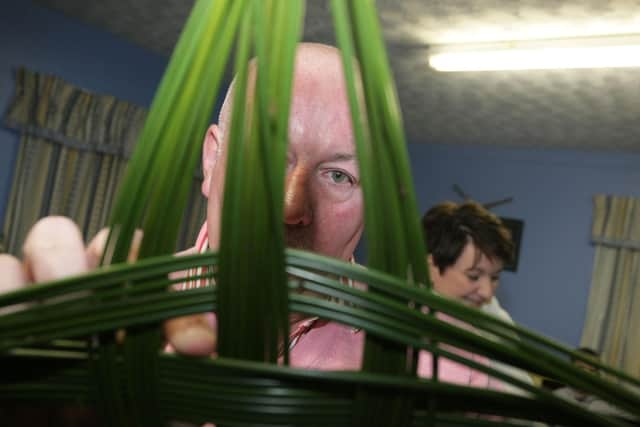

That, according to one yarn, is why St. Brigid’s crosses are made to this day.
Years ago every member of a household would leave out a piece of clothing for the wandering saint to warm herself with as she went around the country.
Doors were left ajar and a good fire kept on in case St. Brigid would stop in.
This year her Feast, on February 1, marks the 1501st anniversary of her death.
Brigid was born at Faughart between Dundalk and Newry in the middle of the fifth century and is said to have died in 525. She is, however, most closely associated with Kildare.
Her feast coincides with Imbolc (the coming of spring in February) – one of the four main seasonal festivals of the ancient Irish year alongside Samhain (Halloween], Beltaine (the coming of summer in May) and Lúnasa (the summer harvest festival in August).
A glance at the Irish Folklore Commission’s treasure trove of local tradition collected from schools in the 1930s illustrates that the cutting of rushes and fashioning of St. Brigid’s crosses was a widespread practice in this part of the world.
Arthur Peoples, a pupil at Castlecary, supplied his teacher Mary S.J. Donaghy, with the following information about the local customs around Ballyrattan in East Inishowen:
"A tradition still carried on in this locality by most of the people is by gathering a bundle of rushes the day before St. Brigid's Day.
“The man of the house cuts rushes and goes round the house three times, each time he comes to the door the same prayer is said.
"The rushes are placed underneath the tables, and the people are all invited to take of the meal. The rushes are woven in crosses. A cross is put in every house, and that is to keep away ill luck, and to bring good luck for the coming year.”
The crosses, Arthur said, were blessed by St. Brigid that night and a garment was taken from each member of the house and left outside so that ‘St. Brigid may find warm wraps on her way’.
"The door is left on the latch, and a good fire is put on, so that St. Brigid may warm herself on her way.
"I saw rushes gathered, and the crosses made and then hung up in the out-houses, over the byre and stable-doors,” he related.
Over at Grianán Ailigh, school pupil Philomena MacGrath, corroborated Arthur’s evidence telling schoolmaster Niall S. Mac Aoidh that on ‘St Brigid's night some people leave a cloth outside before going to bed’.
It was Charles McGarvey, who attended St. Garvan’s near Glenvar in Fanad, who was told the story about St. Brigid’s encounter with the poisoner by his grandmother Ellen McGarvey.
"One night when St. Brigid was in Connacht she went into a house and she asked for a drink. The woman of the house gave her a drink but she put poison in it. St. Brigid lifted a rush and made the sign of the cross on the water and drank it.
"The man of the house asked her why she did that and Saint Brigid said that the woman put poison in the water.
"Then the man asked why she did that and the woman began to cry and said, that she wanted to have the cross that Saint Brigid had and we make crosses in honour of her on the last night of January,” Charles explained.
Rose McLaughlin was a 13-year-old pupil at Aughaclay near Ballindrait.
She told her teacher Seán Ó Beirn that children would go out and cut a bundle of rushes on St. Brigid’s Eve.
"When night comes he or she goes out and gets the bundle of rushes and knocks at the door. The people inside ask ‘Who is there?’ The child outside answers, ‘St. Brigid. Go down on your knees. Open your eyes, and let St. Brigid in’.”
Rose explained how people inside would ‘welcome St. Brigid’ and the child outside would open the door and come in with the bundle of rushes.
"They then start to make crosses. In some houses they make ‘poundies’ on this night. When all the crosses are made the people of the house shake holy water on them before they put them up. A cross is put above the door of each of the office houses,” said Rose.
And according to Mary Teresa McCrossan of Newtowncunningham, the making of St. Brigid's crosses was one of the oldest customs practised in the country.
"On the eve of St. Brigid a ceremony is gone through by the people of the house. Everything is cleaned up early that night. If one of the household is called Bridget, she goes out and gathers a bunch of rushes.
"She knocks at the door and someone inside tells her to come in, in Irish. She comes in and leaves down the rushes. They are then blessed and every one of the family makes a cross.
"Nobody is allowed to speak while making them. If anybody comes in while the crosses are a making a cross should be given to him. These crosses are placed above the door. Sometimes they are placed in out-houses, especially in byres, to bring good luck and health on the stock,” she said.