
Pollanroe Burn exhibition by Emily McFarland focuses on shifting ecology of the Sperrins and Foyle system
Up on the Tyrone side of Dart, just south of Park, stands ‘the Last Man on the Mountain’.
A holdover from the ice age, he is the only known survivor in Ireland.
"They call it the 'Last Man on the Mountain' because they think it is male though they are not sure,” says Emily McFarland.
The ‘Last Man’ features prominently in the Belfast-based artist’s new exhibition Pollanroe Burn at Void, an examination of the ‘shifting ecology of the Sperrin Mountains of West Tyrone...in the shadow of proposed major industrial-scale gold extraction’.
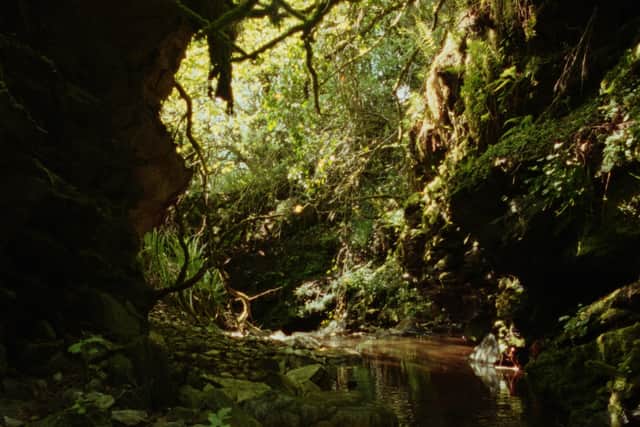

The title of the exhibition, Pollanroe Burn or An Pollán Rua (the little red pool), refers to a small riverlet, which rises near Greencastle, before flowing down to feed the Foyle system.
The work consists of a series of films shot on 16mm that are the fruits of Emily’s long-term research amid the ancient landscape just south of Derry.
"The first work, Pollanroe Burn, traces the flow from the Pollanroe, on to the Owenreagh and Owenkillew, and its convergence with the Strule.
“It follows the Mourne from Sion Mills to its confluence with the Finn where they form the Foyle river, flowing on to Culmore Point and then finally down to Lough Foyle at Moville where it becomes the Atlantic Ocean,” says Emily.
For a year Emily has been making sonic field recordings in the area and in a collaboration with the Belfast-based composer Liam McCartan has produced a score.
Radio frequency readings from the river system itself have been given their own musicality.
"He has created a soundscape using those field recordings isolating parametric frequencies within the sound data to create almost instruments, and this speculative soundscape, recreating this river as a living, resonant body.”
The exhibition asks whether it is ‘possible to conceive of the river and other similar non-human entitles as active, rights bearing presences’.
“I was really interested in this idea of slow looking and quiet listening,” Emily adds, explaining how the Pollanroe film follows the river in real-time.
A fascinating second film, ‘Cloudberry, after MPH Kertland’, follows in the footsteps of the eponymous Belfast-based botanist who went searching for the ‘Last Man on the Mountain’ in the 1950s and provided a personal written account of her discoveries.
The ‘Last Man’ in question is a singular cloudberry rhizome that is still there.
"It is a relic of the ice age. It is the only recorded example of the cloudberry across the whole island of Ireland. There have been sightings here and there but it has never really been confirmed. This is the only real example. They are still studying it,” she explains.
The cloudberry was first formally identified in 1826 by a Professor Murphy and Admiral Jones though it would be surprising if the people of the area were not aware of its presence long before.
Emily’s film concentrates on MPH ‘Paddy’ Kertland’s fieldwork over 100 years later.
"The plant had been recorded but was afterwards declared extinct. She went back to the mountain in the late 1950s to look for the cloudberry.
“The film traces her journey across the mountain, the written account of her visit, and her rediscovery of the cloudberry.”
A third film focuses on the remnants of an ancient Scots pine forest preserved in a former commercially harvested peat bog near An Creagán.
‘Haughey’s Bog’ was produced in collaboration with Ulster Wildlife who are rewetting the peatland after years of extraction.
"The twisted remnants of an ancient 5,000 year old Scots pine forest have been preserved in the peat. The remnants partially contributed to the end of the viability of the commercially extractive site.
"So that was really interesting, a non-human resistance to extraction in the form of this ancient forest that has been preserved.”
Emily has been researching in the Sperrins for five of six years. She has also been delving into the national folklore collection in Dublin and looking at a lot of the oral traditions that were recorded in that part of the world.
The exhibition incorporates text, narrative and folklore collected by Michael J Murphy, a field collector in the late 1940s.
Partly due to its isolation, the Sperrins was the last place in Ulster outside Donegal where Irish was spoken as a first language until well into the 1900s in some parts.
"That area was known to be an area where the last native speakers in the Tyrone area lived,” Emily acknowledges.
The Sperrins are rich in history and ancient lore. Not far from where the Pollanroe rises at Greencastle stands the 'Aghascrebagh' – field of writing – stone. Erected in memory of Dotetto Maqi Maglani around 300-400AD it is one of the only examples of Ogham in Ulster.
Nearby stands Beaghmore, which has been described as the ‘most extensive concentration of stone circles’ in Ireland. The area is abundant in folk wisdom.
"Some of the folk knowledge in the film is linked to ways people would have divined water or interpreted the weather, for example. It also relates to unexplained geological phenomena,” Emily says.
As part of the exhibition members of the public will be invited to contribute to this growing corpus of knowledge as part of the 'living river archive'.
"It is a new research initiative alongside the Pollanroe exhibition, focusing on gathering human and non-human personal and emotional responses and care and connection and folk knowledge of the Foyle and its tributaries.
"It's aiming to gather and uplift stories and reflections from the Foyle catchment area as evidence and encountering narratives generated by capital's extractive imperative,” says Emily.
Pollanroe Burn launches at Void on Saturday, September 27, from 6-8pm, and runs until Saturday, December 13.