
Shared experience of colonialism in focus as indigenous delegation builds on historic Derry solidarity
Krystal Two Bulls spoke of the Irish and Lakota people’s connected experience of colonialism on a visit to Derry this week for the Bloody Sunday Trust’s Peace and Conflict International.
“We've only been here one night but I love Derry. I was here two years ago with another delegation, which is what birthed this,” she says.
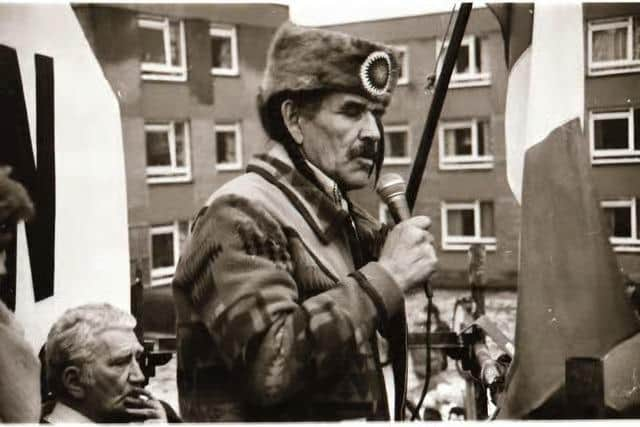
The Oglala Lakota and Northern Cheyenne organiser is looking forward to building on a solidarity stretching back to 1985 when Floyd Westerman (Dakota) and Clyde ‘The Thunder Before The Storm’ Bellecourt (Ojibwe) travelled to Derry to take part in the the annual Bloody Sunday commemorations.
“We always knew there was that history and that relationship but we just got here and learned Clyde Bellecourt from the American Indian Movement was here with Floyd Westerman and Yvonne Swan [Sinixt],” Ms. Two Bulls confides. “Those were some of our predecessors who laid down the road for us to even be here.”
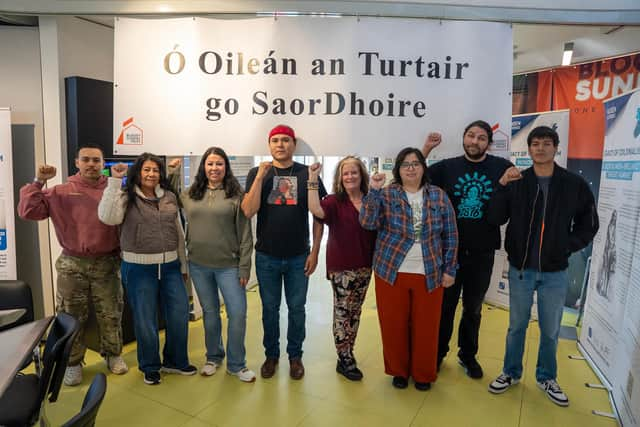

An Executive Director of Honor the Earth, a women-led organisation working for indigenous sovereignty, environmental justice and community empowerment, the Lakota leader is in Derry as part of a delegation of indigenous activists attending the Bloody Sunday Trust’s Derry Peace and Conflict International and its Developing International Solidarity programme.
Building on a relationship first forged 40 years ago is ‘extremely important to us right now’, she admits.
"I think that in this moment a lot of the struggles that we are facing, the symptoms that come from settler colonialism and the historical trauma, that is what we are dealing with now. A lot of that stuff has global roots and so we have to address them at that level.
"A lot of the problems don't just happen to us in the so-called United States. They are happening globally and, in fact, maybe have already happened to other peoples,” she reflects.
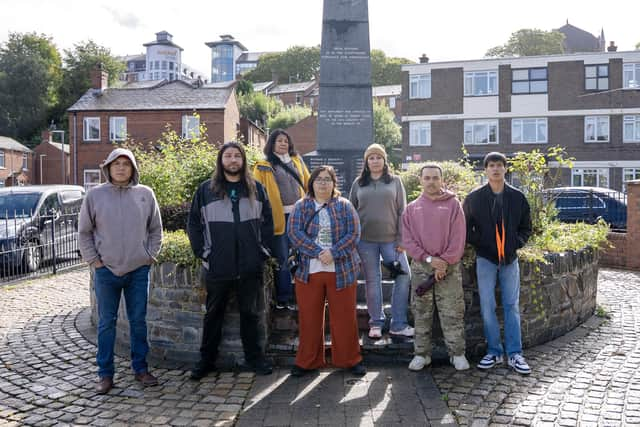
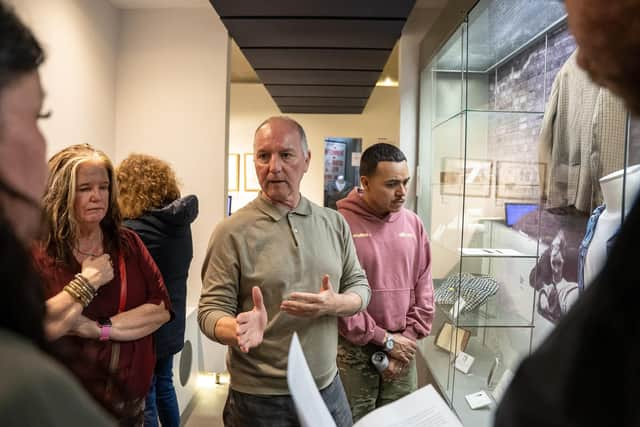
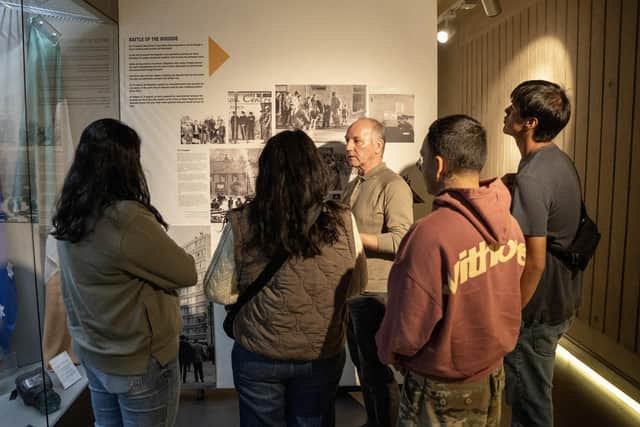
On the first morning of the delegation’s trip to Derry they toured the Bogside and visited the Museum of Free Derry.
They were struck, says Ms. Two Bulls, at how truth was suppressed here and local testimonies muted in favour of other narratives.
"One of the things I related to going through the museum was about the silencing, and not having a voice.
"I think for many generations our people have been invisible on our own lands. We are less than two per cent of the population in the so-called United States. So our struggles and our stories have always been invisible. We don't even show up on statistics because our rates and our data are not even valued in that space either,” she reflects.
One of the most insidious impacts of colonialism, experienced in Ireland and the Great Plains at different phases, has been the damage done to indigenous languages leading to linguicide in some cases.
Rafael ‘Tufawon’ Gonzalez Jr., is a Dakota/Boricua rapper, singer-songwriter and teaching artist, who is in Derry for the solidarity week.
“We are in place right now where language is a dying thing and it is really important for us to speak it and to use it more.
"I have to take my own personal accountability and learn it and engage in it way more, especially to honour our ancestors for continuing to speak the language when they would get persecuted for it. They potentially could have gotten killed for it so it makes me want to delve deeper into learning our languages for sure,” he says.
Ms. Two Bulls explains how up until the American Indian Religious Freedom Act was passed in the 1970s the expression of native culture was actively suppressed.
“There was a point in time where it was literally illegal for us to speak our language, to practice our ceremonies, or practice any of our cultural traditions or lifeways. It was only because of activists and organisers that we even got the right to speak our own language again,” she notes.
Boarding schools, she adds, were another instrument that contributed to language loss.
“For me, when I think about the single most effective tool used against us, it was boarding schools, where they literally kidnapped our children, they were sexually assaulted, they were physically assaulted and mentally and emotionally abused in that timeframe, as children.”
Those who survived this regime of indoctrination were afraid to speak their language or practice their own traditions.
"So then you get generations like myself and my mum who don't speak the language because they were so scared of passing it on and now we are in a moment of having to go back and reclaim that.”
Based in Lame Deer in the Northern Cheyenne Indian Reservation Ms. Two Bulls became involved in indigenous rights, social justice and ecological activism in order to protect a way of life. She didn’t become an activist, activism came to her, she asserts.
“Most of us got into this work because we were just living our lives and being who we are. Then insert extractive industry trying to mine coal or build a pipeline through our territory or trying to kidnap our children and send them to boarding schools.
"We are just trying to be who we are and to follow the instructions given to us by our creator and our stories and our teachings. That's all we are trying to do...if there was any other way to just be who I am as a Lakota woman or Cheyenne woman on this earth and not get attacked for it then that is what I would do but I can't. Therefore I have to step forward and make the decision to protect those things, to protect the air, the land, the water, where all of our teachings come from.”
‘Tufawon’ acknowledges a recent growth in interest around the rights of nature globally as a positive. But equally he points to how the current administration in the United States has been especially hostile towards grass-roots environmental and land rights campaigns.
"A lot of protected lands are being opened up potentially for mining and extraction so I think it is even more important for that growth to happen now. The urgency has always been there but it is a lot more urgent. It's dire,” he warns.
Colonialism, he says, exists to take these resources away from indigenous nations and that is why there is a need to build solidarity globally.
Ms. Two Bulls says the conversation around the rights of nature is welcome but cautions against the potential danger of such well-meaning legislation being used to further dispossess or exclude indigenous peoples.
“The big critique around it is how governments or colonial governments go about it when they push those things forward because it removes native and indigenous peoples from that entity, whether it is a lake or a mountain or a river or whatever the body is that they are trying to give personhood but they are not separate from us.
"We don't consider ourselves as a human being separate from the land or the air or the water. We are all in this together, one thing, like a living being.”
Based in Minneapolis ‘Tufawon’ uses the medium of hip hop to promote social change. In addition to his indigenous activism he used his profile to protest the deployment of Immigration and Customs Enforcement (ICE) anti-immigration officers to the streets of the Twin Cities earlier this year.
“It is important to speak out against fascism, extractivism, the oppression that we are seeing right now. I think that is super important,” he says.
His latest single ‘No One Is Illegal’ is a protest record for the times.
"It speaks out against Trump [Donald, the current US President] and his administration and really speaks to Operation Metro Surge and the current ICE situation that is happening,” he says.
‘Tufawon’ admits that when he toured the Museum of Free Derry and heard first hand about the murder of 14 innocent anti-internment protesters in Derry on January 30, 1972, he ‘saw so many parallels of just like what is going on back home and what happened here’.
He called for justice for Renee Nicole Good (37) and Alex Pretti (37) both of whom were shot dead by ICE officers in Minneapolis in January.
"To see the story of the 14 people who were murdered on Bloody Sunday and them being innocent and that announcement was like 'wow'. We haven't got to that point yet but it's something we are all fighting for and want to see.”
Ms. Two Bulls hopes this week’s visit will cement an existing bond and lay the foundations for further collaboration.
“It's very clear and it's very obvious that we have a history in that we have a shared storyline. It may have happened on different timelines but it is shared. But how do we go forward from there? What are we actually building towards and how do we support each other in that?” she asks.