
Q&A with talented Derry artist John O'Flaherty-Lynch
We spoke with talented Derry contemporary landscape artist John O'Flaherty-Lynch ahead of the former St Peter’s and St Joseph’s pupil’s planned first solo exhibition in 2027.
Tell us a little about yourself and your artistic journey…
I grew up in Derry with my four brothers and sisters. We are all very close, and my family are all very supportive. As a child I was always passionate about art, I was always drawing and painting at home, and my parents always encouraged it. Like any child of the ‘80s, if I wasn’t playing with Star Wars I was playing with Lego and I’m a huge fan of Lego to the present day and that whole curiosity around building and exploring.
If I’m not painting today my thought in my morning are always about painting, and when not painting I’m glued to the Premiership watching Liverpool FC. Last season was really tough, but hopefully this season with Iraola will be a fresh approach.
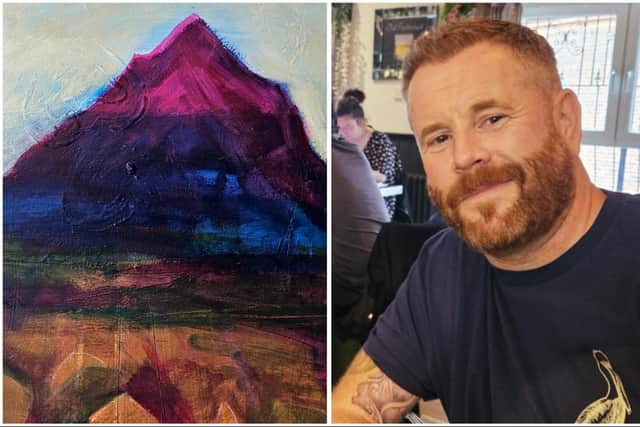

I’m happily married four years now in October to Niall. Niall continues to be my biggest fan. Art has always been my passion and my first love. At school I went to St Peter’s and then to St Joseph’s and then onto Ulster University where I studied Design, and after that I completed the PGCE in Education.
Who was your biggest artistic influence growing up?
The two biggest influences growing up were my two art teachers. One was Pat Cowley at St Peter’s, a very well known Irish landscape artist who passed away in recent years. The second one was Barry Turton at St Joseph’s, who was very much into mixed media. I can’t over-estimate the influence they had on me. I was completely in awe of those two men because as they could draw or paint absolutely anything.
As someone passionate about art at a young age I just thought those two were fantastic, that transference of skills, how to draw, paint, use more complex materials like clay, print. They identified in me that I was good at art. I knew that at a very young age. There were people in my class brilliant at Maths, great at P.E. but I was good at art.
I’m an art teacher today because of those two people. They were my heroes and my mentors. The environment they created was a safe space where you were allowed to have self-expression. They were just two really good men as well.
My uncle Alan was the only other member of the wider family who was involved in art. I remember going to my granny’s in Creggan – he was at art college but came back at the weekends and they had the attic converted for him – going there and watching him and having conversations about art. As a child I would be watching him draw and how he blended colours and his thought process, he was my hero.
Having spent over 20 years teaching, how does the energy of your students influence your private studio practice?
This September will be the start of my 24th year teaching art. I love teaching and I’ve always wanted to be a teacher. That saying about finding a job you love and you’ll never work a day in your life is so true. As a head of Department I frequently tell my team: we build the environment before they come into class so that they look forward to it. They know they are coming into a learning environment and that there will be a shift in pace, in energy. The radio is on and they are not coming into a classroom but an art studio. I believe Art is as important as Maths and English especially now post-Covid. We bring that energy and they meet your energy. Their curiosity, their energy, it energises you and it keeps you young.
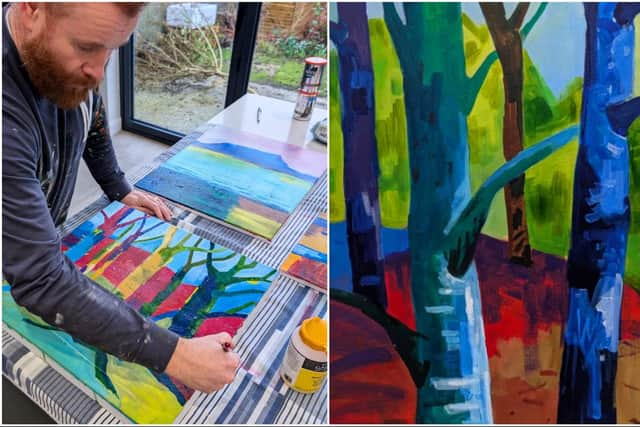
When we were young we were drawing from books from the library, but now they have the Internet. We learned about dead white men. They are coming along with a lot of different artists, and a lot of female artists. I take more risks in my own studio practise because of them.
The skills I’m transferring haven’t changed that much: the components of drawing, the pencil and paper – the classic bowl of fruit, but it’s about how you are teaching them to break rules, and where are they taking it next. That is the big thing now in teaching. I talk to them about my practice, the artistic block, you share that and it’s good for children to know their art teacher is also an artist and understands what they are going through. I think that’s important.
How do you transition a rugged Irish landscape into a deeply emotional and abstract concept on canvas?
I’ve always found green spaces really interesting and I think in Ireland we are blessed with green spaces.
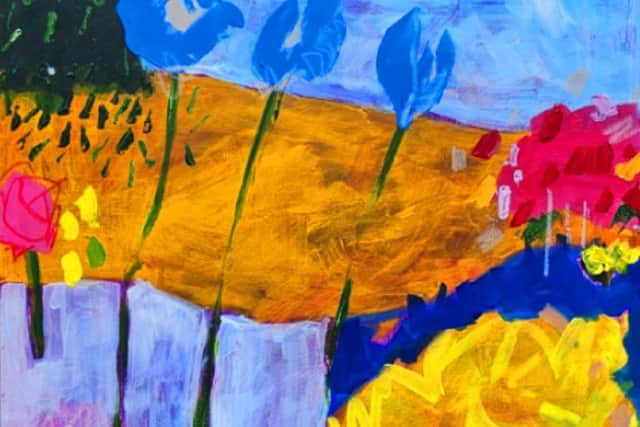
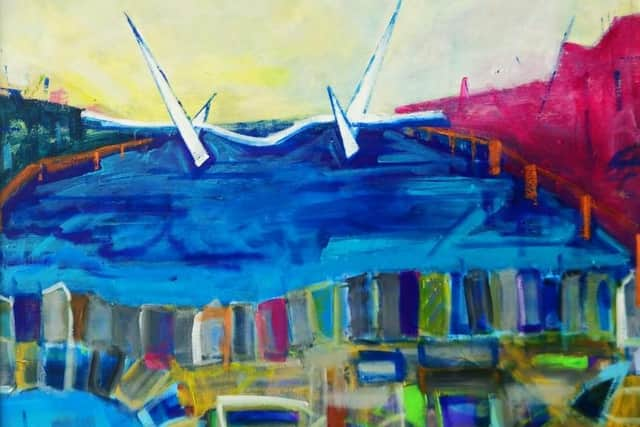
I can drive to Donegal and look at any Donegal landscape or drive to Slieve Donard or up in the Mournes. When I am out in that space I am observing, reviewing, studying the landscape. I always bring my camera, take lots of pictures but I don’t want to paint everything. That’s not my style; that’s not who I am. When I look at geography of the landscape I see colour and shapes and it’s my job then to reduce it all down to energetic mark making and tactile textures.
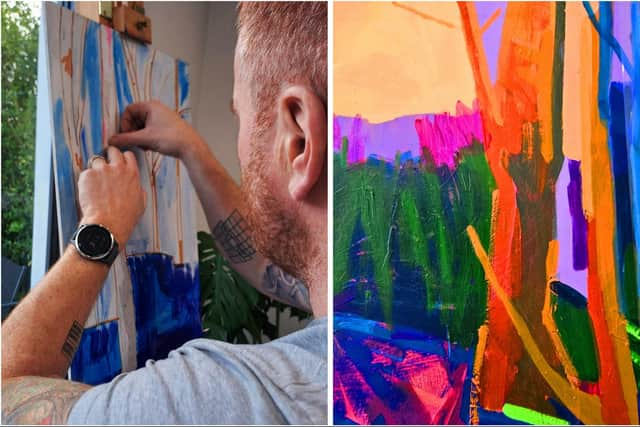
It’s really exciting. You are suggesting marks. My own colour palate is not what is out there but it’s how I see it and how I interpret it and as artist I have creative licence to do that. That’s me taking that risk. I use loose energetic brushwork, sharp lines. It’s an expressionist technique.
Memory and emotion play a significant role in your paintings. Can you describe how a memory becomes a finished artwork?
As an artist you just paint and what other people take from it you will never know.
A number of years ago I started to do a range of paintings of Cave Hill. One client who bought a painting and who no longer lived in Ireland but grew up in that area said it brought back fond childhood memories and the shape and colour brought up joyful emotions, and another person who bought one said it just reminded him of his father as his father used to walk up there with him. It’s lovely to be part of that story and narrative for someone.
My own work is deeply fuelled by a sense of escapism, freedom and exploration. I think it comes from my own childhood memories. We spent every summer in Donegal, in Portsalon or Clonmany and Ballyliffin. They were brilliant memories. Going out to play in Clonmany, around Urris you have fields, hills, rivers and streams to explore and that backdrop to me as a child was a great playground. Then there were films we loved like Young Guns, The Goonies and Into The West, the characters and thinking we were in this new magical landscape. It always stuck with me. Donegal is a place very close to my heart because of those emotional, nostalgic memories that remind me of the adventures with my brothers. Then it’s transferring those memories onto a canvas, painterly marks in a dramatic, cinematic colour palette that reflect that landscape to evoke a memory; to transform a memory into an emotional painting for the viewer.
Your use of colour is particularly striking. How do you decide on the palette for a piece?
In my process all canvases are painted using a bright pink acrylic wash and this is borrowed or taken directly, as this is what they used to do to kill off that intimidating white canvas and it adds a bit more warmth to a work. I’ve always liked colour. My colour palette is never chosen simply to replicate, it’s to capture the energy and textile of the landscape. I’m not afraid of colour. I don’t do any pre-drawings. I have photographs but in my mind’s eye, I envisage what it is going to look like. Some of the people who influenced me like Vincent Van Gogh, David Hockney they both used vibrant palettes and non-naturalistic colour to capture nature. I’ve always been drawn to that.
I use primarily acrylics which allows me to layer colour up. You need an anchor colour and I have two or three, usually blues, violets, pinks then you try to offset it with another colour.
How does it feel to see audiences connecting with your paintings?
A lot of my work is sold through the galleries in and around Belfast so I often don’t know who bought them. Sometimes they contact me afterwards through Instagram and talk to me about why they bought it. I love hearing that feedback and it’s a lovely complement. I think people in general when they look at artwork, it can bring a deep sense of joy and wonder for them because maybe they share that memory I have. I do think landscapes can trigger memories and sometimes people connect with the artist, the style, the colours or sometimes it’s bought as a gift and they grow to love it and it reminds them of a particular person who bought it and a particular memory of a time in their life.
Have you encountered any barriers or obstacles in your artistic journey?
The main challenge for any creative person is the doubt. The doubt that you are good enough, your work is good enough and trying to silence that inner saboteur. I am my own biggest critic. You are always trying to improve, develop. That is just a process. Rejection is part of the process. I’m very lucky in the last couple of years I’ve had a lot of success in the galleries around Belfast. But there’s a lot of ‘no’s as well and you have to take it on the chin and you have to develop a thick skin. As your work improves those doors are never closed. You have to follow your heart, your dreams. You get one life and you have to go for it. You have to back yourself.
I had the opportunity to go to America in Easter. I was talking to galleries and one in particular was very interested and they invited me over. It was going brilliantly. Niall my husband went upstairs and we found out it had the American and Israeli flag there. That put the hairs in the back of my neck up. I talked to someone and was told the gallery was funded from people in Israel. I was respectful, and we left. It didn’t matter the opportunity… you cannot support genocide. That’s it, black and white.
That’s one door closed for there but opportunities will come around again. I’m not doing this to get into galleries, I paint for me and I’m very grateful to get into galleries. I just want to be an artist, I just want to paint and my husband Niall is a great supporter and advocate for me.
You recently donated your piece to auction for Mencap NI to highlight the escapism that green spaces offer individuals with learning disabilities. How do you see the relationship between abstract art and community advocacy?
My friend’s sister is involved in the board and they asked me if I would donate a painting. It was auctioned at Down Royal and it raised a lot of money. They do brilliant work and I was very delighted to be asked and to support a charity that works with children and young people with learning difficulties. The piece was ‘A Walk In The Park’ about escapism and freedom. I think abstract art and the promotion of greenspaces are brilliant for positive mental health, being in nature. For me I’ve been involved with a couple of different charities and donated a painting so people can raise funds. It just makes sense.
As your work continues to be showcased across Ireland, where do you see your visual language heading next?
The use of oil paint really interests me and seeing what comes from that.
I want to broaden my subjects into the south of Ireland. I’m planning to go down along the west coast with a camera. I’m interested in working with other galleries and if anyone has any commissions they can get in touch. The next big thing for me is a solo exhibition in 2027 and finding a venue for that. It’s exciting times.
You can view John’s work or get in touch with him via www.jofl-artist.com and at Instagram at https://www.instagram.com/johnoflahertylynchartist/