
RV Tom Crean sets sail from Derry to monitor fish, dolphin, porpoise and whales
The RV Tom Crean has set sail from Derry with a team of scientists on an expedition to monitor fish and marine mammals in the North Channel between Ireland and Scotland.
The research cruise set off from Foyle Port at the weekend.
Scientists from the Loughs Agency and Atlantic Technological University (ATU) will redeploy underwater listening devices allowing them detect tagged fish as they move through the North Channel.
The equipment will also record the sounds of marine mammals such as dolphins, porpoises and whales.
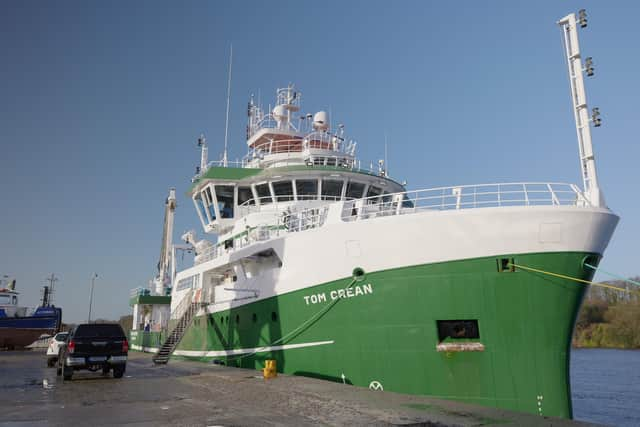

The expedition is due to conclude on Saturday, February 28.
By monitoring how animals move through the North Channel as part of the EU Horizon-funded project Strategic Infrastructure for Improved Animal Tracking in European Seas (STRAITS), researchers can provide evidence to support sustainable management and conservation measures.
Rachel Morgan, Chief Scientist for the mission and Scientific Officer for the STRAITS Project at Loughs Agency, said: “The North Channel is one of the most important marine gateways around Ireland.
"By redeploying our acoustic receivers and passive listening devices, we are rebuilding a vital underwater monitoring network. This allows us to track salmon and other fish as they migrate, while also listening for dolphins, porpoises and whales that use these waters.
“This work is about understanding movement, where animals go, when they travel and how they use this environment. That knowledge is essential if we are to protect vulnerable species in a changing and increasingly busy marine landscape.”
The expedition is funded through the Research Shiptime Programme of the Marine Institute. STRAITS is one of several active research initiatives led by Loughs Agency, alongside NorTrack, DTOTrack and MOSAIC.
Alongside redeploying telemetry equipment, the team will collect environmental data about temperature, depth and salinity, to build a detailed picture of conditions beneath the surface.
The scientists will also use a suite of advanced marine technologies including a side-scan sonar to map the seabed and locate equipment that may have shifted or gone missing, Remotely Operated Vehicles (ROVs) to visually inspect and assist with underwater recovery operations, while acoustic release systems and lander pickers will safely retrieve seabed moorings.
ATU is leading the passive acoustic monitoring of cetaceans within the STRAITS Project.
Dr Joanne O’Brien, Principal Investigator at ATU, said: “By listening to the underwater soundscape, we can detect dolphins, porpoises and whales that might otherwise go unseen. This technology allows us to build a clearer picture of how cetaceans use the North Channel and how best to protect them in a changing marine environment.”
Aodhan Fitzgerald, Research Vessel Operations Manager at the Marine Institute, said: “The Marine Institute’s Research Shiptime Programme provides researchers with access to Ireland’s national marine research vessels, enabling high-quality scientific studies that support evidence-based policy and sustainable ocean management. We are pleased to support Loughs Agency and its partners as part of this STRAITS expedition, which demonstrates how access to national research vessels can strengthen collaboration and generate the scientific knowledge needed to manage and protect our seas.”
More information on STRAITS and other marine research projects can be found at loughs-agency.org and europeantrackingnetwork.org.