
Derry/Strabane presents ‘most acute combined peace challenge’ in the North, say researchers
Derry and Strabane presents the ‘most acute combined peace challenge’ in the North with higher homicide, paramilitary activity and weapon crime rates and poorer outcomes on poverty, GDP and housing.
That’s according to the North’s first Peace Index (NIPI) - a composite measurement of negative and positive peacefulness over time – that was published this morning.
Researchers from Queen’s University Belfast, in partnership with the Institute for Economics and Peace (IEP), measured ‘negative peace’ and ‘positive peace’ across all 11 Local Government Districts between 2019 and 2025.
‘Negative peace’ measured the absence of violence and fear of violence, while ‘positive peace’ captures the attitudes, institutions and structures that create and sustain peaceful societies.
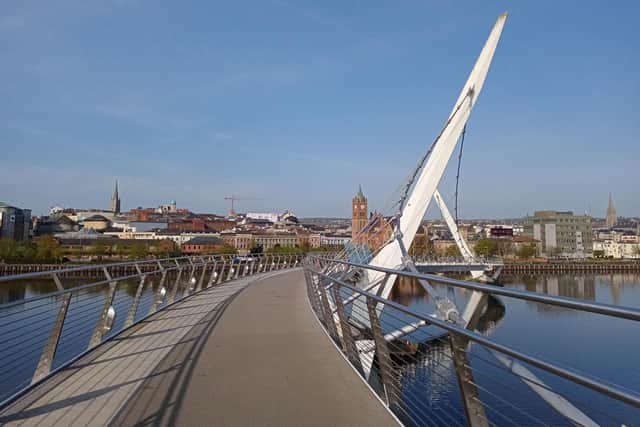
According to the index Derry and Strabane scored below the average for the North on a range of ‘negative peace’ measures, including violent and weapon crime (-1.04), paramilitary activity (-0.73), homicide (-0.67), public disorder (-0.41), hate crime (-0.40) and worry about crime (-0.14).
This led the authors to declared that ‘Derry and Strabane presents the most acute combined peace challenge in Northern Ireland’.
"On negative peace, the council recorded the highest rates of any LGD on paramilitary activity, over three times the region-wide figure and exceeding Belfast’s, and the highest homicide rate, approximately two and a half times the NI average.
"Violent and weapon crime and public disorder also sit well above the regional level. Hate crime recorded a past-year fall of 20 per cent, the second largest single-year improvement on this indicator across the councils.
"The paramilitary activity rate is structurally embedded rather than transitional. Causeway Coast and Glens, Belfast City and Ards and North Down were the other three councils above the region-wide level in 2025,” the report maintains.
Derry and Strabane also recorded the ‘weakest aggregate composite among the councils on positive peace’ with 10 of 11 socio-economic indicators trailing the regional norm.
On R&D spending (-1.27), poverty (-0.58), GDP per capita (-0.51). confidence in the justice system (-0.44), school segregation (-0.40), planning decision efficiency (-0.22), cross-community socialising frequency (-0.12), gender pay gap (-0.10), social housing processing (-0.06), and Gigabit capable broadband (-0.03), Derry/Strabane underperformed the region.
Only on primary health care access (+0.02) did Derry/Strabane exceed the level of the North as a whole.
"R&D spending is 1.27 score points below the NI level, poverty 0.58 below and GDP per capita 0.51 below. The composite improved only 0.5 per cent since 2019, the joint-smallest improvement among all councils.
"Similarly, a cross-UK Deprivation Index ranked the council, along with Belfast, as one of the most deprived local authorities in the UK, with 45 per cent of its zones in the most deprived 10 per cent UK-wide.
"In 2025, both dimensions of peace face structural deficits here, with the sharp single-year improvement on hate crime being the most positive movement in the profile and its durability the key indicator to track in the next edition,” the authors note.
The report also found that while Belfast recorded the strongest positive peace position among the LGDs, it had the highest concentration of recorded violence.
Derry and Strabane, meanwhile, recorded the weakest positive peace position, but witnessed some of the largest improvements in violence-related measures since 2019, notwithstanding the still higher rates of homicide, paramilitary activity and weapon crime aforementioned.
The research was led by Dr Andrew Thomson, Principal Investigator, and Professor Dominic Bryan, Co-Investigator, from the Institute for Global Peace, Security and Justice at Queen’s University Belfast with the Institute for Economics and Peace and funded by the Economic and Social Research Council (ESRC).
Dr. Thomson from Queen’s said: “The findings in this report give us both reasons for optimism and reasons to carefully assess what might come next. Northern Ireland is much less violent than before, but the foundations for peace have not consolidated at the same rate.
"The challenge now is to continue to strengthen the conditions that sustain peace; building trust in institutions, investing in communities and the economy, and addressing the structural inequalities and weaknesses that can leave peace vulnerable.”
The research team highlighted a number of areas which need to improve in order to sustain long-term peace including private-sector investment for innovation and to create high-value jobs, accelerated house-building, and improve trust between government and citizens.
Co-Investigator Professor Bryan from Queen’s commented: “As the Institute for Economics and Peace has shown in developing peace indexes around the world, policies of positive peace are something that all societies need to work on.
“This report aims to understand peace in a much more ambitious way. The idea of a ‘positive peace’ challenges us to look at the conditions in which people thrive. It allows us to identify strengths and weaknesses in a process that has been underway for over three decades and to make some comparisons with other parts of the world.
“I hope the report provides a model that can be used by organisations working on peace to strategically develop their work as well as open-up debates over peace building and ‘good relations’ policies at regional and LGD levels.”
Brett Savill, Chief Operating Officer from the Institute for Economics and Peace (IEP) remarked: “IEP is proud to be working with Queen's University on this important project. Positive Peace is a transformational concept whose time has come in Northern Ireland.”
The IEP along with the Queen's research team have also developed a toolkit for practitioners and policymakers which is available at https://nipi.economicsandpeace.org/data/NIPI-2026-Practitioner-Toolkit.pdf/
The first Northern Ireland Peace Index report is available at https://nipi.economicsandpeace.org/data/Northern-Ireland-Peace-Index-2026.pdf/