
Families of Derry British Army victims vow not to engage with ‘legacy act’ information recovery body
The families of several victims of the British Army have vowed not to engage with the new Independent Commission for Reconciliation and Information Recovery (ICRIR).
The body was established under the controversial NI Troubles (Legacy and Reconciliation) Act 2023.
While Secretary of State Hilary Benn has said the British Government will scrap the ‘Legacy Act’ he has indicated the ICRIR will be retained.
At a ‘Living with Injustice’ event, organised by the ‘Empower Project’ at Creggan Neighbourhood Partnership during the Féile, the families of victims and the human rights group, the Pat Finucane Centre, gave their views on the ICRIR.


The event was coordinated by award-winning author and Bloody Sunday family member Julieann Campbell.
The audience heard from John Kelly, brother of Michael Kelly (17) who was shot dead on Bloody Sunday; Martin McGavigan, brother of schoolgirl Annette McGavigan (14), who was shot dead by a British soldier in 1971; and Fiona Gallagher, whose brother Jim Gallagher (20) was killed by a British soldier in May 1976.
PFC’s Sara Duddy said: “The Legacy Act became law in September last year, but the main provisions took effect on May 1 this year. It had three aims: 1) Close down the current legacy mechanisms including inquests, police investigations, civil actions and investigations by the Police Ombudsman; 2) Introduce a conditional immunity scheme; and 3) set up a new body called the ICRIR.
“The Act received universal condemnation from victims and survivors, political parties, the Irish government and the international human rights community.


"Labour had pledged to repeal the Act and reinstate inquests and civil actions during the election campaign. The conditional immunity clause was deemed unlawful by the High Court earlier this year, and the government withdrew their appeal to the Court of Appeal on this issue.
“Now we have a clearer idea of Labour plans. They said they will reinstate inquests prematurely stopped and bring back civil actions. However, it is not clear if new inquests will be granted, or if those inquests granted just before the Act became operational will go ahead.”
Ms. Duddy said there was equally no clarity on whether the Police Ombudsman’s power to investigate police wrongdoing would be reinstated.
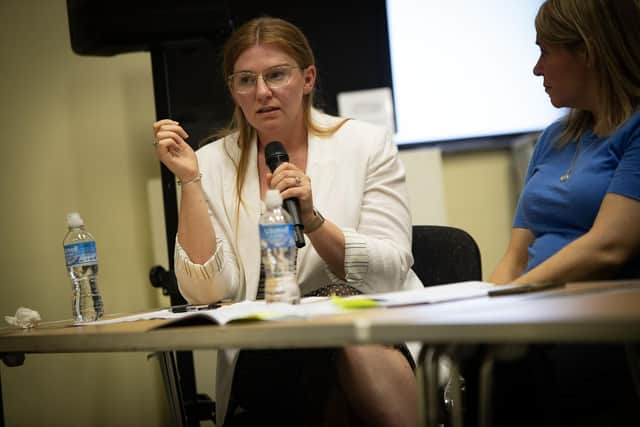
She described the Secretary of State’s decision to keep the ICRIR as ‘very worrying’.
"Families have been consistent vocal in their opposition to this body as it was established against their will and with human rights safeguards including the insurance of independence, stripped out of the legislation,” she said.
Annette McGavigan was 14 when she was shot dead in her St. Cecilia’s uniform.
Her brother Martin said: "Her death was so devastating for our family, especially my mother and father. Just before the May 1 deadline we found out that the soldier who shot her dead would not be prosecuted.
"It was awful. We waited in the PFC until after 4pm and then heard the news. My world collapsed. Almost immediately after, our solicitor rang to say that the Attorney General granted us a new inquest.
"We hoped if Labour won the election that this would go ahead, but now we are not sure. But we are clear that we will not engage with the ICRIR. There is so much uncertainty and it is awful.”
John Kelly insisted: “It doesn’t matter if it’s a Tory government or a Labour government, you can’t trust them to do what’s right. But you have to keep fighting and never give up.
"We didn’t think we would get this far, and our journey for justice isn’t over, but we will keep going and I urge other families to do the same.”
The family of Patsy Duffy, who was shot dead by undercover soldiers in Derry in 1978, stated: “The inquest into our father’s death was stopped in February this year because the Ministry of Defence persuaded the Coroner that they couldn’t complete the discovery process before the May 1 deadline.
"We were then asked to send our case to the ICRIR. We don’t want the ICRIR. We don’t trust it and we won’t engage with it. No families do. They need to stop wasting time with it and just let us have our inquest,” they stated.
Ms. Duddy said: “We would urge families not to engage with the ICRIR and voice your opposition.
"Talk to your elected representatives and raise awareness with the public about this issue. It’s also important that the Irish government does not appease the British government by accepting a half measure that won’t deliver for victims and survivors.”
Ms. Campbell, Empower Project Coordinator said: “It is vital victims and survivors are given a platform to share their views on these important issues, and for the public to hear first-hand, what the impact has been of the devastating Legacy Act.”
In response to the concerns raised an ICRIR spokesperson said: “Since May, the Commission has been working with the many victims, families and survivors who have approached us in relation to their cases.
"The commission is always open to meeting with and hearing feedback from anyone who wishes to input to how the Commission can work to best serve all.
“Listening and responding to constructive feedback are essential and we will continue to do this, building on the High Court's ruling that we are ECHR compliant and the Secretary of State’s statement of confidence."
A NIO spokesperson said: "We are committed to repealing and replacing the Legacy Act, and to establishing legacy mechanisms that command the confidence of victims and survivors. It would be irresponsible to repeal the Act with nothing to replace it.
"In July the Secretary of State began the process of repealing the Act, setting out steps to remove from the statute book the conditional immunity scheme and other provisions deemed by the High Court to be unlawful.
"The Court found the ICRIR to be independent and capable of conducting human rights compliant investigations. However, it’s vital that it can command the confidence of victims and families, so we will propose measures to strengthen its independence and its powers and consult widely on these and other changes."