
'How can it be bad?' US President Donald Trump would 'love' to see a united Ireland
Politicians from Derry and across the north have been reacting to US President Donald Trump saying that he would love to see Ireland reunified.
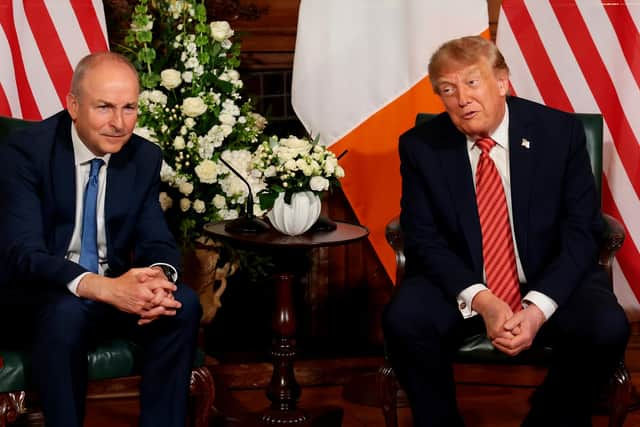
The president expressed his support for reunification as he addressed the media while meeting with Taoiseach Micheál Martin at Farmleigh House during his two-day visit to Ireland at the weekend.
When asked for his view on the matter, the President said: “Well I don’t want to cause any problems but I will tell you I would love to see it unified. I have friends on both sides, great people. They're Irish people, how can they be bad, right?
"I'd love to see it unified. I think it would be a great, a great feather in everybody's cap if that happened. You know what? The way I look at it, it's going to happen eventually. It may as well happen now.”
He said he had spoken with the Taoiseach about it and added, “you’ve got the right man here to get it moving. I think it would be a fantastic thing."
"How can it be bad?” he added. Trump later reiterated the same view several times during his visit.
Mass protests took place in the south during the President’s visit, with a ‘Wanted’ billboard featuring his face also erected at Free Derry Corner.
Derry’s SDLP MP and long-term critic of the Trump administration, Colum Eastwood shared a clip of the President’s comments on his social media and quipped ‘Always liked him’.
While criticising Trump and the US role in the genocide in Gaza, Sinn Féin Leader Mary Lou McDonald described his comments on Irish reunification as “timely”.
"The Taoiseach must now begin planning for a united Ireland,” she said.
The surprise development however led to criticism from Unionist leaders in the north.
DUP leader Gavin Robinson posted: “President Trump knows better than most that elections matter. Northern Ireland’s constitutional future will be decided by the people of Northern Ireland, not by commentary in London, Dublin or Washington.”
“Northern Ireland is part of the United Kingdom because that is the settled democratic will of its people. I am confident NI will continue to choose the UK and the security it offers.”
TUV leader Jim Allister said: “Northern Ireland not a pawn in Trump’s fall out with the UK. Our constitutional future does not depend on him or any other foreign dignitary.”
Across the Atlantic, representatives from largest Irish American organisation in the United State, the Ancient Order of Hibernians, welcomed Trump’s remarks.
In a joint statement, AOH National President Sean Pender and AOH Political Education Chair Neil F. Cosgrove said: “If Unionist leaders truly believe that Northern Ireland’s future belongs in the hands of its people, they should have nothing to fear from clear criteria, transparent assessment, and an honest democratic process. One cannot champion the people’s right to decide while simultaneously opposing the democratic mechanism by which they are allowed to do so.”
They added that the the United States cannot “simply be dismissed as an outside voice with no legitimate interest in this discussion”.
“American diplomacy was central to the peace process that produced the Good Friday Agreement, and successive administrations have remained engaged in defending that agreement and encouraging peace and prosperity in Northern Ireland,” they stated while calling for the appointment of a U.S. Special Envoy for Northern Ireland and for British Government to “establish and publish a clear and transparent process for assessing when the statutory conditions for a border poll have been met”.
"President Trump has expressed his view. British Prime Minister Burnham and the Northern Ireland Secretary have expressed theirs. The final decision does not belong to any of them. It belongs to the Irish people, it is time to give them the mechanism to express it.”
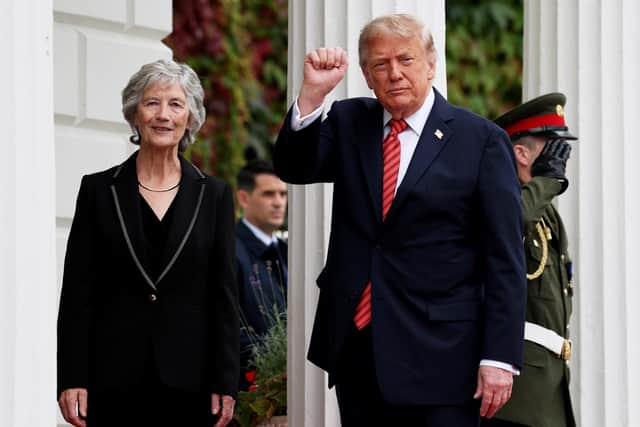
The US contribution to the Peace Process was also mentioned on Saturday by Uachtarán na hÉireann, Catherine Connolly, along with the genocide in Gaza, as she met with Trump at Áras an Uachtaráin. President Connolly said afterwards: “I conveyed the strong view of the Irish people that the normalisation of war and genocide can never be accepted.”