
Derry and Strabane record highest spike in sectarian hate incidents and crimes
Derry and Strabane recorded the highest increase in sectarian offences in the North over the past year with incidents up a significant 23 per cent.
Between July 2024 and June 2025, 159 sectarian hate incidents were reported to police in Derry and Strabane. That's up by 30 (23 per cent) from 129 during the equivalent 12 months last year.
The number of sectarian hate crimes, meanwhile, rose by 17 per cent locally.
From July 2024 to June 2025 there were 115 hate crimes reported in Derry and Strabane; up by 17 (17 per cent) from 98 year-on-year.
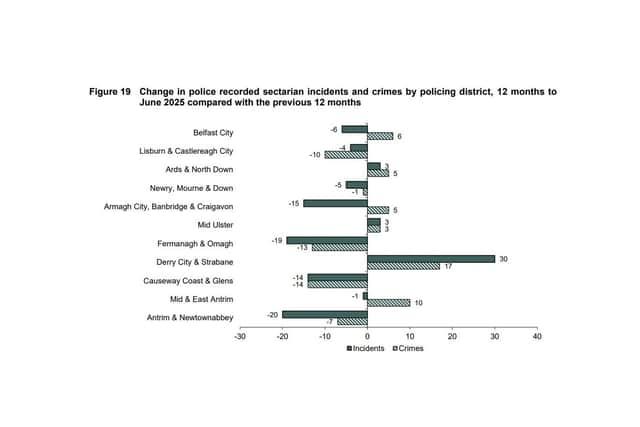

In absolute numbers Derry and Strabane recorded the second highest number of incidents (159 in Derry and Strabane; Belfast had 206) and the second highest number of crimes (115; Belfast had 218) between July 2024 and June 2025.
Derry and Strabane bucked the trend across the North where there were 921 sectarian incidents recorded, a decrease of 48 on the previous 12 months. The number of sectarian crimes recorded by the police rose by one to 611, when compared to the previous 12 months.
"Eight of the eleven policing districts showed a decrease in the number of sectarian incidents and six policing districts showed an increase in the number of sectarian crimes.
"Belfast City policing district, which accounts for around one in three of all sectarian incidents and crimes recorded in Northern Ireland during this time period, recorded 6 fewer incidents (306) and 6 more crimes (218),” the latest PSNI bulletin on hate crime states.
According to the latest PSNI 'sectarian incidents generally tend to peak in July of each year and such levels may be closely linked to unrest during this period'.
The lowest levels tend to be recorded between October and February, the PSNI said. And over the past two decades there has been a general decline in sectarian incidents.
The authors of the bulletin explain: “The number of sectarian incidents was at its highest level in 2009/10 with 1,840 incidents recorded. Levels generally fell between 2009/10 and 2018/19, which was the lowest financial year figure in the data series and less than half of the peak level recorded in 2009/10.
"The number of incidents increased in each year between 2018/19 and 2022/23 before falling in 2023/24 and 2024/25. The number of sectarian crimes fell to its lowest level in 2017/18. Levels rose in each subsequent year up to 2022/23, before falling again in 2023/24 and 2024/25.
"The crime level recorded in 2024/25, which is the second lowest in the data series, is 60 per cent lower than the highest level which was recorded in 2005/06.”
The PSNI acknowledge that ‘sectarianism’ is not clearly defined and that it has a particular meaning in the context of the North where it is almost exclusively used to describe ‘incidents of bigoted dislike or hatred of members of a different religious or political group’.
"It is broadly accepted that within the Northern Ireland context an individual or group must be perceived to be Catholic or Protestant, Nationalist or Unionist, or Loyalist or Republican. However sectarianism can also relate to other religious denominations, for example, Sunni and Shi’ite in Islam,” the bulletin says.