
Over 90% of sun to be obscured by moon in Derry and Donegal in deepest solar eclipse until 2090
Over 90 per cent of the sun will be obscured by the moon in Derry and Donegal during the deepest partial solar eclipse to appear in Ireland until a scheduled total eclipse of the sun in 2090.
Between 6pm and 8pm Wednesday, August 12, the Moon, Sun and the Earth will almost perfectly align, turning day into night for a brief moment in Derry and Donegal.
Experts have suggested that 93.7 per cent of the sun’s surface will be blotted out in Derry. Estimates for Donegal range from 93 to 95 per cent.
In Derry the eclipse is expected to start at 6.09pm. It will reach its mid point at 7.07pm. And it will conclude at 8.02pm.
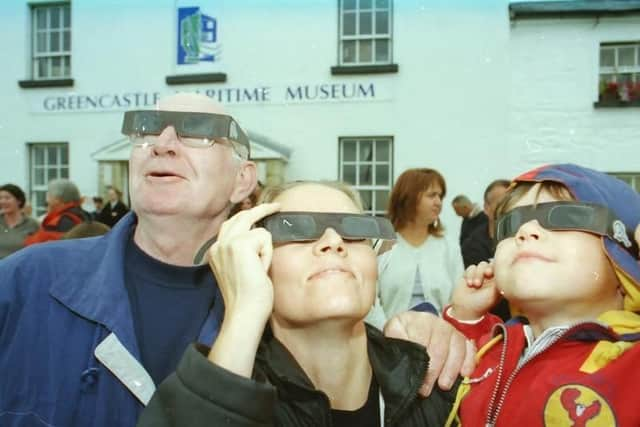

The last time the North West experienced such an extensive eclipse was in 1999.
Astronomy Ireland stated: “This is the deepest partial solar eclipse from Ireland until the full total eclipse of the sun visible from the southwest of Ireland in 2090.”
Research Ireland explained: “Although we will not be able to view totality from Ireland, it will be a near-total solar eclipse of 94 per cent as seen from Dublin and the highest amount will be up to 97 per cent seen from the very southwest of the country, from Dunmanway in Cork to Dingle in Kerry.
“We will not get to view another solar eclipse like this in Ireland until 2090, so let’s get out there and see it!”
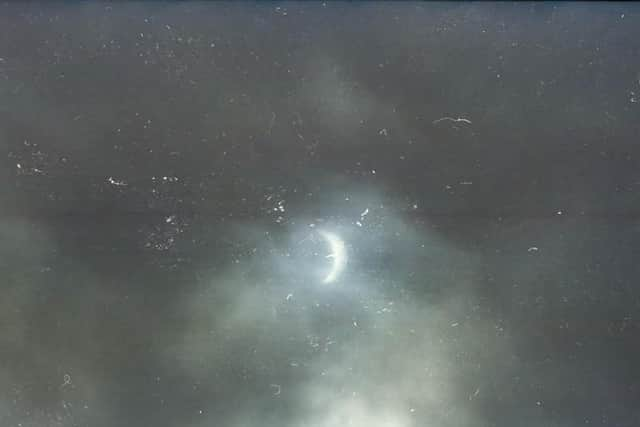
In an article for ESERO Ireland – a project by the European Space Agency (ESA), co-funded by Research Ireland – John Flannery of the Irish Astronomical Society explains what to expect.
"Changes in the ambient light level will only become apparent though when the sun is nearly 80 per cent obscured. That is often experienced as an abrupt fall in brightness as our eyes compensate for the changing light levels in a logarithmic way rather than linearly.
“As the eclipse deepens further, your surrounds can take on a strange hue, as if colour is being bled out of the landscape. This transformation takes place as our eyes shift from daylight/colour perception towards night/monochrome vision.
“Shadows are now becoming noticeably sharper too,” he writes.
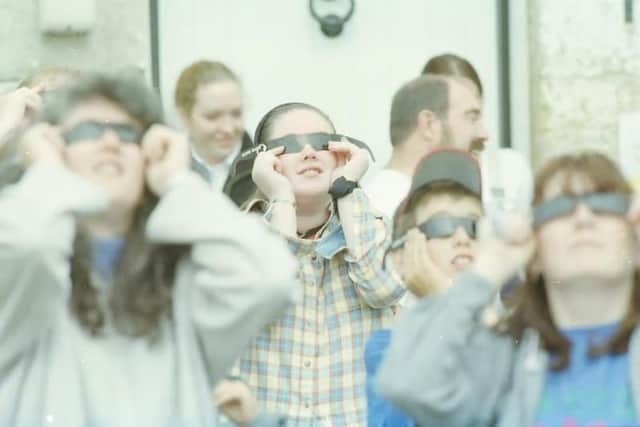
By mid-eclipse ‘the sky will appear darker than expected, but the light levels are still generally equivalent to a heavily overcast winter’s day, or ten to twenty minutes before sunset on a clear evening’.
"The sun’s low altitude at this time may have an impact on what we anticipate though.
"From locations in the far southwest of the country, where the sun is almost 98% eclipsed, the more pronounced darkening of the sky will likely cause some streetlights to automatically switch on, while birds will start to roost early,” he adds.
After mid-eclipse the process reverses itself and the sun will slowly reappear.
Members of the public are advised to be mindful of eye safety as the fraction of sun remaining mid-eclipse is still unsafe to stare at directly without taking proper care.
Under no circumstances should anyone ever use binoculars or telescopes to view the sun.
Special solar eclipse glasses should be used to view the eclipse directly, however, instructions on how to construct a variety of easy-to-make indirect viewers have been provided by ESERO Ireland and can be found at https://eclipse26.ie/activities/