
Riveting history of republican jailbreaks features daring escapes from Derry Jail
Prior to its closure on March 31, 1953, many a republican had been held faoi ghlas – locked up – over the years in the old Derry Jail on Bishop Street.
The imposing prison was later demolished in the most part to make way for the redeveloped Fountain Estate, however, before then it was the scene of some of the most daring republican escapes of the past century and more.
Jailbreak: Great Irish Republican Escapes, 1865-1983, by author and historian James Durney, provides a comprehensive overview of liberations from British jails in Ireland, Britain and even Australia, and needless to say, Derry features prominently.
Indeed, a whole chapter, fittingly titled ‘I wish I was (n’t) back home in Derry’ focuses specifically on the once looming edifice on Bishop Street and on the jailbreaks that were executed by IRA prisoners over the decades.


The springing of Frank Carty, O/C of the Tubbercurry Battalion of the IRA, from the prison on February 15, 1921, is mentioned only in passing.
Carty was being held in Derry due to his involvement in the Chaffpool ambush in Sligo in September 1920 when RIC inspector James Joseph Brady was killed.
He was successfully freed by an IRA unit commanded by the famous Derry republican Charlie ‘Nomad’ McGuinness who had been ordered by GHQ to direct a rescue.
Durney notes: “Derry jail, on Bishop Street, in the loyalist Fountain area, had a long history of republican resistance. It was the scene of a daring escape of top Sligo republican Frank Carty on February 15, 1921.”

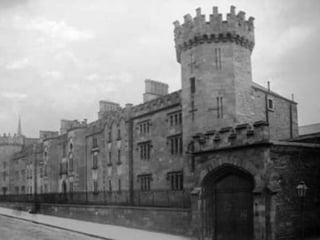
The author relates how 85 years ago at the height of the festive season republican internees in Derry staged an uprising within the jail: “On Christmas Day 1939, republican prisoners took over the jail protesting against their continued incarceration without charges or trial.”
The Kildare historian concentrates more closely, however, on the most famous jail break of all in the local prison’s history, referred to by some as the ‘The Big Derry Jail Escape’ when 21 members of the IRA successfully absconded.
In October 1942 IRA prisoners started digging a tunnel from Harry O’Rawe and Jimmy O’Hagan’s ground floor cell.

Within five months they had sunk a shaft 15 feet deep and extended a tunnel a further eighty feet to the home of a Mr. Joseph Logue in Harding Street.
"The prisoners removed fifteen tons of clay from the tunnel in pillowcases. They sifted and disposed of the clay around the prison yard or flushed it down the jail toilets,” writes Durney.
Apparently the sewers were blocked twice as a result of the disposal of the dirt but the authorities never suspected the plot.
Music practice was used to disguise the sound of the digging and while some neighbours heard noises at night they too were none the wiser as to what was going on.
Twenty men were initially picked for the jailbreak.
"The escape, set for March 21, 1943, was to be supported by waiting IRA units in Derry and across the border in Donegal. The O/C Tyrone, Jim Toner, and his adjutant, Joe Carant, were put in charge of moving the men out of NI. GHQ would get them away from the vicinity of Derry Jail,” Durney tells us.
IRA Volunteers from Belfast, Jimmy Steele and Liam Burke hired a furniture lorry in Belfast and made their way to Derry.
They repaired to a safe house and parked the lorry at Abercorn Place.

At 8.30am on Saturday, March 21, 1943, a prisoner played the pipes to cover the noise of the men.
"The escapees, bare-headed and their clothes covered in clay and coal dust, crowded into the house of Joseph Logue, a shipping official, who was about to have his breakfast. Startled Logue said, ‘What is this all about?’”
The men made their way from Logue’s house to the awaiting furniture lorry but not without being spotted by a local girl who ran to the prison gate to inform an on-duty policeman.
"He arrived as the furniture lorry drove towards the border and turned the escapees over to the next unit. However, the alarm had been raised, and submachine-gun-toting policemen were on the streets of Derry, holding up pedestrians and vehicles,” Durney informs us.
There were ‘shouts of triumph’ when the escapees crossed the border at Carrigans where they managed to evade customs officials.
Shortly afterwards the Irish security forces rounded up 11 of the escapees on a hill at Glentown Slate Quarries at St. Johnston. Upon being told they were to be dispatched to the Curragh internment camp they said they would rather be sent back to Derry because the conditions were better.
Durney writes: “Irish public opinion was outraged that the men had escaped gallantly only to be jailed yet again...the government eventually saw the point that the Derry jailbreak was a grand stunt, and the escapees were released from the Curragh gradually in small groups.”
The escapees, Durney tells us, were mostly from Belfast. They were: Paddy Adams, Seán Hamill, Liam Graham, Albert Price, Séamus P. Traynor, Séamus ‘Rocky’ Burns, Alphonsus White, Brendan O’Boyle, Hubert McInerney, Harry O’Rawe, Jimmy O’Rawe, Cathal ‘Chips’ McCusker, Liam Perry, Thomas McArdle, Séamus O’Hagan, Seán McArdle, Frank McCann, Daniel McAllister, Kevin Kelly, Hugh O’Neill and Séamus McCreevey.
"Only fifteen of them had boarded the furniture truck. Harry O’Rawe, Hubert McInerney, Brendan O’Boyle, Cathal McCusker and Liam Graham did not go on the truck but successfully made their way on foot to Letterkenny, Co. Donegal.
"Brendan O’Boyle was the last of the designated internees to escape through the tunnel. He got clean away and remained at liberty in Dublin throughout the war, only to die tragically on July 2, 1952, when planting a mine at Stormont telephone exchange.
"Jimmy O'Rawe was the only non-designated escapee to go through the tunnel. Unfortunately, he was unfamiliar with Derry and was picked up by an RUC patrol on a road near the city during the blackout the following night,” the tome advises.
The book is peppered with other incidents of great interest to the local reader.
Durney tells us of Derry-born Chief of Staff Hugh McAteer’s attempts to regain his liberty after he was arrested on October 12, 1942.
McAteer and his Director of Intelligence Gerald O’Reilly, were arrested and taken to Crumlin Road after they arrived at the home of a serving police officer from his old street in Derry who had told him he could provide him with ‘certain useful information’.
While on remand Hugh tried to saw through his prison bars but was moved to another part of the ‘Crum’ after being sentenced to fifteen years for treason.
Desperate to escape McAteer identified a trapdoor in the ceiling of a toilet in A Wing of the North Belfast jail that led to an attic with access to the roof.
Enlisting Paddy Donnelly A Wing O/C, Jimmy Steele, Adjutant of IRA Northern Command, and Ned Maguire, a roof slater by trade, they set off on January 15, 1943.
Accessing the roof without incident they slid down on a rope of knotted sheets and made for the perimeter wall.
Writes Durney: "At the wall, the escapees fixed a hook to a long pole made from brush shafts and strips of leather from the prison shoe shop.
"They wrapped the pole with cloth to prevent noise, and, after some trouble, hooked the barbed wire.
"McAteer was last to go over, but as he reached the top, he fell back into the prison yard and twisted his ankle. He struggled back up the pole, dragged himself over the barbed wire, where he ripped open his hand and fell again, this time on the right side of the wall.”
Hugh was free again and a £3,000 reward was immediately put up for his capture.
A lesser told story relates to a brief sojourn by Sligo republican Linda Kearns in Derry jail.
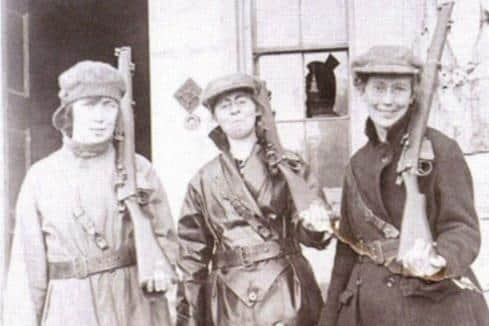
Kearns was one of four women, including legendary Donegal Cumann na mBan volunteer Eithne Coyle and her comrades Mae Burke and Eileen Keogh, who would escape from Mountjoy prison in Dublin on Hallowe’en night in 1921.
Prior to her incarceration in Mountjoy Kearns was held for a brief time in Bishop Street after being brought to Ulster from Mullaghmore on a British destroyer.
"The prisoners were taken off at Buncrana, Co. Donegal, and were marched from Buncrana towards Derry city. After marching handcuffed to an army officer for several hours, a lorry picked them up and brought them the rest of the way to Derry Jail,” recounts Durney.
Kearns was treated well aboard the destroyer where the ‘sailor boys provided me with towel, soap, nail file’ but:
"She was held for a week in Derry Jail where she was the only female prisoner. There was no suitable accommodation there for women, so she was held in the jail hospital. There were no patients in the hospital, and Kearns was guarded by a solitary prison officer – a kind, elderly man who brought her in a clothes iron,” writes Durney, who says she was transferred to Crumlin Road after ten days in Derry.
The book ends with an account of what became known as ‘The Great Escape’ when 38 members of the IRA escaped from H-Block 7 on September 25, 1983, in what was the biggest mass escape in Europe since the Second World War.
Among the escapees were Derry man Kieran Fleming, Dungiven-based Seán McGlinchey and Donegal’s Jim Clarke and Paddy McIntyre.
Jailbreak: Great Irish Republican Escapes, 1865-1983 by James Durney is available in all good book shops and from https://www.irishacademicpress.ie/